
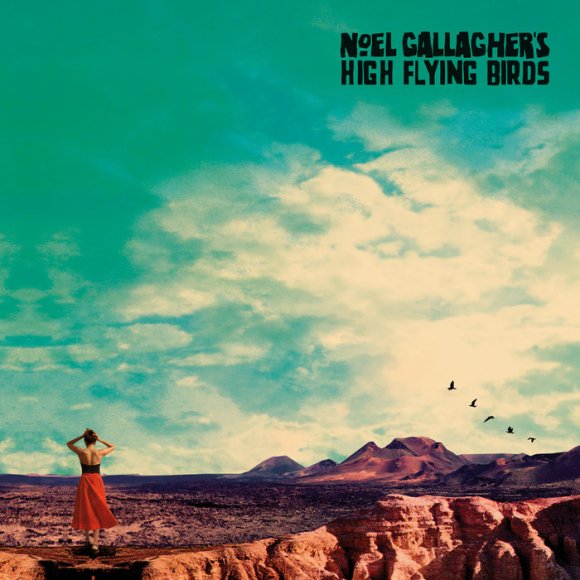
We interrupt our regularly scheduled programming for… something completely different.
On the morning of Friday November 24th, I posted the first in a series on the “Best albums of 2017” list I had been working on for the previous couple of weeks. Later that same day, I went to the record store to purchase “Who built the moon?”, the third album by Noel Gallagher’s High Flying Birds. It sometimes happens when putting these lists together that an album is released so late in the year, it doesn’t get its due because it hasn’t as much time out in the sun as other releases. Unfortunately, I was suspecting this might be the case with “Who built the moon?” because I’d been quite enamoured with all the advance singles. And on the second spin through on Friday night, I found myself agreeing with my friend, Andrew Rodriguez, that we needed to write something about the album.
So here it is, a special honourable mention. I won’t dare to conjecture where this might have sat on my list had it been released one month earlier and I won’t say much more right now than how fresh and energizing a record it is. Instead, I’ll just let Andrew Rodriguez do the talking. And you’ll notice the format is a bit different than the other posts in my “Best albums of 2017” series and that’s because he doesn’t he doesn’t take instruction well and I refused to cut and hack his words. However, this also means there might be some strong opinions (some of which I may or may not share) and some possibly offensive language. Enjoy.
Well, this is likely one of the most tardy reviews of Noel Gallagher’s High Flying Birds album, “Who Built the Moon?” I am writing this 19 days after the release (in Canada), 17 days after I first started writing this review – and countless days after atrocious, inaccurate, inapplicable, essentially lazy, wrong and just outright horrid reviews have been written elsewhere (I’m talking about the Guardian and NME). Why the tardiness? Well – I am a busy individual and MLIML is a busy place – and one with certain (high flying) standards.
John mentioned to me a couple of months ago that there was a single out – and a HFB album forthcoming. That single was “Holy Mountain”. I was immediately hooked. See, I have nearly from day one, been a fairly unabashed fan of Oasis, and really, all that they ‘stood’ for. Not a Kool-aid drinker, but a fan nonetheless. A fan of the whole package. Of course, Oasis are history now (in several ways). I mentioned being ‘immediately hooked’. The first time I heard “The Death of You and Me” from the debut HFB album – I was just that – hooked. It was so different. I have always had a very clear sense of what I like and what I don’t like. I am open to new things, and open to changing my mind – but on some level, I respond very decisively to new material. “Death of You and Me” hooked me instantly. And the album overall was excellent. The next HFB outing – it took a bit of time for me to warm to it. John and I had many conversations about that. While we live in different cities these days – we always keep in touch. So when John brought “Holy Mountain” to my attention – I watched the video. Over and then over again. I was hooked.
John alluded to how ‘energising’ the record is. And I agree. “Holy Mountain” – first listen.
Not nearly so ‘psych’ as ‘professional music critics’ would so lazily suggest. “Holy Mountain” has a great driving rythm. More uptempo than what fans are accustomed to. And when I am talking about fans – I am talking HFB fans. It has a gloriously Northern Soul-esque feel and tempo, which (having heard only the single not the whole album) I was uncertain of after the first listen – more on that in a moment. Unlike what ‘The Guardian’ had to say – it is not even remotely Slade-esque. I like Slade. NG likes Slade. NG is a shameless ripoff artist. This doesn’t sound a thing like Slade. Youtube comments “I love the flute player – so retro with his hair – like the Beatles”. It wasnt a flute. And the musician looks nothing like a Beatle. If anything – he looks like Clint Boon of the Inspiral Carpets – early 90s. Around when NG was a roadie for that band (which has been mentioned in these pages before should you wish to do some homework).
There are some guests on this album. Paul Weller (the Jam, the Style Council, solo) plays organ on the track. This is not the first time that NG and PW have worked together. Minus a lot of his later solo efforts, I am a lifelong PW fan. I will admit I didnt really pick up the organ sound on “Holy Mountain”. What I DID pick up on – NGs driving vocals, and – the Bass. The basslines in “Holy Mountain” are such that – well if they don’t make you at least tap your feet – then you should be in the emergency room – not reading this.
The next single to come out was “Fort Knox” – many have likened that to Primal Scream (admittedly, I am not overly familiar with them – I like a bit of their material – I thought it sounded a bit more like Stereo MCs).
Ultimately, who the fuck cares what something sounds like??? Other reviewers relish the opportunity to parade their Google driven knowledge of music and rub it in other peoples faces. I do not do that. MLIML doesn’t do that. These are the impressions of Andrew Rodriguez and if you are wise – you will just take them as such. “Fort Knox” starts out with a crescendo – it reminded me of an airshow – just a ‘ROOOOOOOOSH!’ – well after the twangy sort of guitar intro. Then, it keeps the tempo. It sounds like a song that you would really want to listen to on repeat if you are on Ecstasy (which I can’t condone but would not shout down either – you are adults). And in the absence of the chemicals, it – much like old hymns, spirituals and some classical music – CREATES A SENSE OF ECSTATIC EXPECTATION. Now – when i first heard this song I had not heard the album yet. Spoiler alert – “Fort Knox” is the opening track. As such – it is a BRILLIANT choice. HFB really put thought into the track order on the album. And this album has actually been in the works for almost 4 years. I’ve mentioned ‘tempo’ several times. But that is just it. Anyone who has listened to past HFB outings will know that they tend to be almost like movie soundtracks. NG has a very locked in view of what a listening experience should be. I think that is partially why he so openly and freely rips off other music – he is “I like that – I’ll nick that”. Why? Well, he loves music as much as we do. He realises what works and what doesn’t work and has an extremely high level of competency when it comes to assembling a bunch of songs and placing them in an order that essentially creates a cathartic experience. You don’t need the drugs. “Fort Knox” is hypnotising.
Next Single was “Its a Beautiful World”.
Now this one – I will admit – I was not as hooked on the first listen. John loved it. I have since come around. A little more pensive. Slightly slower tempo. But still purposeful. Sort of like the antidote to “The Ballad of the Mighty I”. The video may cause seizures in some viewers so be forewarned. The change in Noel’s pitch during the chorus – I find beautiful. Noel can hit high notes – and I remember years back thinking that they sound ‘strained’ – but if you listen closely – he doesn’t waver. Noel hits the high notes. Now if I was writing for NME that would have been my final line. But it isn’t. And fuck them. Their review was a bad as the Guardian’s was.
But those were the singles – released before the album. Now, some minor biographical info – John and I have known each other for close to 30 years. We are frequently in contact. Once John had told me the date of the release for the Album – I was so excited! As I mentioned above – I was already hooked. Thus, started my text countdowns. Every morning – I would text John with the countdown. When the album finally came out, I listened to it early on the Friday. I was instantly taken with it. Grabbed by the orgiastic introduction of “Fort Knox”, yes – okay I can listen to this song again. Oh – ‘HI!’ second track is “Holy Mountain”. Sure I can listen to this again. Next up – never heard this before – “Keep On Reaching”. FULL STOP. My first thought after hearing track 3 – was ‘cue it up again’. THIS was Undiscovered Country – although – in hindsight – not unsurprising country. Now recall I mentioned Northern Soul earlier – well – yeah. Now it all began to make sense. “Keep On Reaching” is easily my favourite track on the album. It has a heavy late 60s Motown feel. Noels voice is CREDIBLY soulful – tempo is just right. And the basswork (Jason Falkner) combined with the horns and the drums – it is a masterpiece. I cannot rave about it enough. Listen to it yourselves oh dear reader. If you get it – you will GET it. And if you don’t? HA.
But again – just when you think that you ‘get it’…you DON’T. Why? Well because we are dealing with Noel Gallagher and the High Flying Birds. And they are anything but predictable on this album. Further in the vibe subtly changes. You end up with “Be Careful What You Wish For”. Borderline litigation territory (not the NG is a stranger to that). ‘Come Together’ much? Regardless. A brilliant tune, and a cathartic change of pace from the opening few tracks. And then – for me – the real show stopper – “Interlude”. No band could believably include a track like “Interlude” on the same album as the first three songs. How a moody soundtracky sounding acoustic dreamy melody could fit in? Well, again – you need to listen to it. This is another track that caught me. And I repeated it several times before moving on. Just a beautiful and moving progression of sounds and notes. And case in point that a song does not need to be uptempo and driving to hit your soul straight on. Last highlight for me was the (sort of) title track. “Man Who Built The Moon” brings the entire album full circle. The first time I heard it – I just thought “Next James Bond Film theme”. And it should be. It melds the soul of the earlier tracks with the moodiness of “Interlude” – throws all of the seemingly disparate ingredients together in one big sonic pot and lets it reach the boiling point. You cool off with the second “Interlude” – and then get prepped to listen to the album again.
For the rest of the albums in this list, check out my Best Albums page here.
 My (life in) music lists