
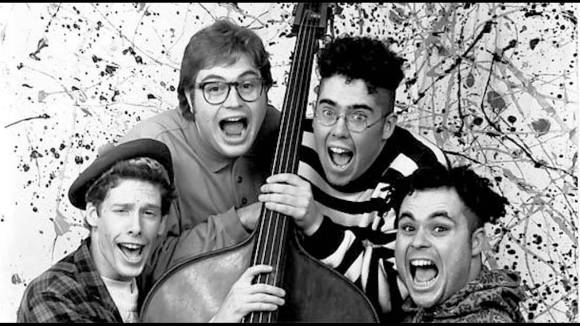
Pay no mind to the above photo. Barenaked Ladies were cool in 1991… Well, okay, we thought they were at the time anyway.
The duo of Ed Robertson and Steven Page formed in 1988, adding band camp friends, brothers Andy and Jim McCreegan, two years later. Tyler Stewart joined the same year to temporarily fill Andy’s spot while the drummer went to Europe and then, stayed on upon his return. The band made a name for themselves with their hilarious, energetic, and often improvisational live shows, a fame that only grew with their DIY videos that they made using a video booth in downtown Toronto called “Speaker’s corner”, and that became a notoriety when they were banned from playing the city’s live New Year’s Eve show because of their “provocative” name. Then, their self-produced and self-released five song demo tape, the now famous “Yellow tape”, became the first ever indie release to reach platinum level sales in Canada. Needless to say, that attracted all the right attention. They released their debut album, “Gordon” in 1992, another classic. Six years later, BNL hit it big in the US with the single, “One week” and the rest is history.
But just as they were getting started, even before “Gordon”, they recorded this cover of Bruce Cockburn’s “Lovers in a dangerous time” for a tribute called “Kick at the darkness”, from a line taken from this very song. Bruce Cockburn is a Canadian icon, a prolific singer/songwriter, whose lyrics are part poetry, part social activism. Inspired by watching teenagers kissing and the thoughts that invoked, “Lovers in a dangerous time” is one of his more popular songs and one of the few I would recognize as his if you played it for me.
Going back to listen to Cockburn’s original before writing this post, I realized how dated it sounds. It is still a great song and the way Cockburn sings it is just right but it really does sound so 1980s. I almost think I like Barenaked Ladies’ cover more than the original, blasphemous though that statement might be. It’s no surprise they chose to cover one of his more popular songs, a bigger one being that they played it straight, something rare for them in those days. The cover is really quite lovely with Robertson’s and Page’s now familiar vocal harmonies, the acoustic guitars, and Creegan’s cello providing the backbone.
The cover:
The original:
For the rest of the 100 best covers list, click here.
 My (life in) music lists