

Okay. So I’m departing from this blog’s usual format in order to participate in this cross blog, group collaboration on Bob Dylan (you can check out the work on the other fine blogs here). The album noted in this post’s subtitle doesn’t fit neatly into any of the lists or series I’ve got going right now (at least not yet). And I suppose it’s not the most obvious album or topic to be written about in connection with Bob Dylan but you see, I could never pretend to be the biggest fan, nor the most knowledgeable proponent of Robert Zimmerman. Sure, I went through a phase where I listened to his stuff incessantly a decade or two ago and I still have one of his many ‘best of’ compilations in my iTunes library, but that phase was short-lived and that compilation rarely sees play these days. Still, he’s a great lyricist and songwriter and I really do enjoy a bunch of his tunes. I just happen to find myself inexplicably more receptive to his compositions when they are covered by other people.
And he has been covered a lot. Other folk artists started covering him immediately, as I understand it, well before anyone else really knew who he was. The Byrds made a career out of covering his songs and doing it well. And if you google “Bob Dylan covers”, you’ll see that countless artists, many themselves influential, have covered him over the years. (There’s even a Wikipedia page listing all the cover versions and it goes on for days.) So we can all agree, he writes great songs and he’s influenced everyone who’s anyone but what else do we really know about him, other than he sings quite oddly and incoherently these days and that he won the Nobel prize for literature last year.
This is sort of what Todd Hayne’s tackles in his 2007 film, “I’m not there”, which I rewatched last week in preparation for writing this post, partially to get into the mood for writing it and partially because I couldn’t really remember the film. It is a sort of pastiche, and in a sense, a collection of covers in film version. Rather than present a straight ahead biopic, Haynes portrays and explores the different personas, myths, and musical eras of Dylan as six different characters (none of whom are named Bob Dylan), played by six different actors. Each of these were compelling in their own right but special kudos must be doled out to Cate Blanchett, who really rocked her gender-blurring part and made you forget any image you had of her previously.

To go along with these actors and their characters, there are six different stories that play out within the span of the film, seemingly at random, seemingly in different times, seemingly in different worlds, and what we get is not so much an explanation, but rather, an idea. Bob Dylan was a poet, a prophet, an outlaw, a fake, a “rock and roll martyr”, and a “star of electricity”. And at the same time, he was none of these. When asked about the film later, Dylan was apparently typically vague: “Yeah, I thought it was all right. Do you think that the director was worried that people would understand it or not? I don’t think he cared one bit. I just think he wanted to make a good movie. I thought it looked good, and those actors were incredible.”
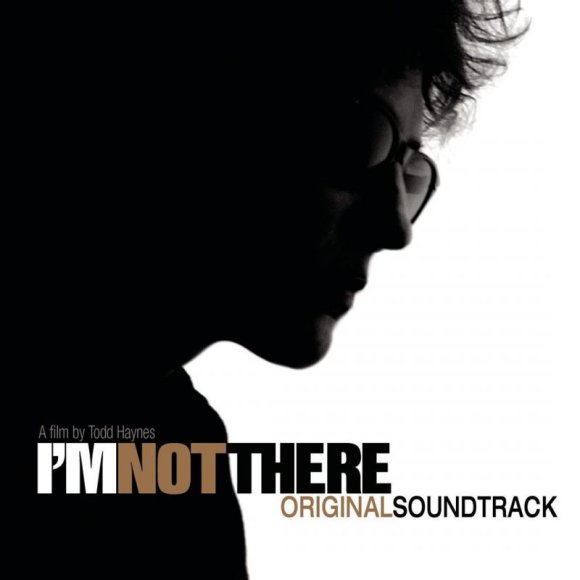
The film’s soundtrack is a double album (2 CD, 4 LP) and just as the film never really references Dylan by name and he only appears briefly through archival footage at its end, Bob Dylan, himself, only literally appears once on the soundtrack, the very last track, in fact, the previously unreleased song from which the film and album take their names. (The rest are covers, so you can see why I like it.) The artists are as varied as the styles and sounds of music applied to the songs, doing a good job representing Dylan’s ability to dabble across the genre landscape with ease. We’ve got blues, Eddie Vedder, bluegrass, The Black Keys, folk, Jeff Tweedy, country, Sonic Youth, rock, and Sufjan Stevens, and through all of this, there still remains a coherence throughout. Another fascinating factoid is that only a portion of about half of the songs on the soundtrack actually appeared in the film. The originals featured more prominently there and I suppose that is how it should’ve been.
Here is a sampling of some of my favourite tunes on the soundtrack and a piece of brilliant Dylan lyric from each:
“Stuck inside of Mobile with the Memphis blues again” by Cat Power: “Stuck inside of mobile” is one of my favourite Bob Dylan tunes, appearing as it did on the “Fear and loathing in Las Vegas” soundtrack, one of my favourite films. Cat Power does an expanded, almost seven minute version of the song and gives it the big band treatment, replete with plenty of horns and some swirling organ work. Her lovely vocal touch is adjusted slightly to adapt to Dylan’s laidback mood of the original.
Fave lyric: “Now the preacher looked so baffled when I asked him why he dressed with twenty pounds of headlines stapled to his chest.”
“You ain’t going’ nowhere” by Glen Hansard and Markéta Irglová: This cover by the principal actors of “Once”, another film with a great soundtrack, doesn’t stray terribly far from the 60s Bob Dylan template, which fits right in with the busking persona that Hansard cultivated in “Once”. There’s heavy handed harmonica and the use of acoustic guitar as rhythm and melody. Hansard is raw and Irglová is the sweet backup sound.
Fave lyric: “Genghis Khan, he could not keep all his kings supplied with sleep. We’ll climb that hill no matter how steep”
“Goin’ to Acapulco” by Jim James & Calexico: I’ve never heard the original version of this tune but this cover by My Morning Jacket’s Jim James and the soundtrack’s house band, Calexico, is quite phenomenal. It also plays quite prominently in an important and super memorable moment in the film, all glorious with imagery and magic, featuring the actual performers of the song, while Richard Gere’s outlaw, Billy the Kid prepares to face his long-time nemesis in Pat Garrett. So much soul, so regal, so beautiful.
Fave lyric: “I’m going down to Rose Marie’s. She never does me wrong. She puts it to me plain as day and gives it to me for a song.”
P.S. As much as I like the soundtrack, I’d be curious as to what the real Dylan fans out there (perhaps some of my blogging compatriots included) think of it.
P.P.S. After all this research, by that I mean watching the film and listening to the soundtrack, I feel like it may be time delve once again in to Mr. Dylan’s catalogue. I’ll let you all know how that goes…
 My (life in) music lists