Categories
Tunes

100 best covers: #48 Sleeper “Atomic”

<< #49    |    #47 >>

“Trainspotting” was a film based on a book of the same name by Irvine Welsh and it was released too much critical acclaim and commercial success at the height of Cool Britannia in 1996. I remember going to see it in the theatres with my friend Tim, when it finally crossed the ocean into the North American market and I absolutely loved it. I later followed many of the actors that made up its young cast as they took full advantage of the film as a stepping stone and went on to great successful careers of their own. I had a copy of the film poster on my residence room wall, duly purchased that year at one of the campus Imaginus fairs, and read the Welsh novel during my next break in studies. And yes, you guessed it, I went out and procured a copy of the film’s soundtrack on CD.

Considered by many* to be one of the best film soundtracks ever, it combines classic alternative tunes from Brian Eno, Lou Reed, New Order, and of course, Iggy Pop, with more contemporary music of the day, which of course meant a smattering Britpop and Techno/Electronica. The mix works surprisingly as well as an album listen as it did match the feel and flow of the film. It ignited a resurgence in popularity for Iggy Pop’s “Lust for life” and made Underworld a household name on dance floors all around the world.

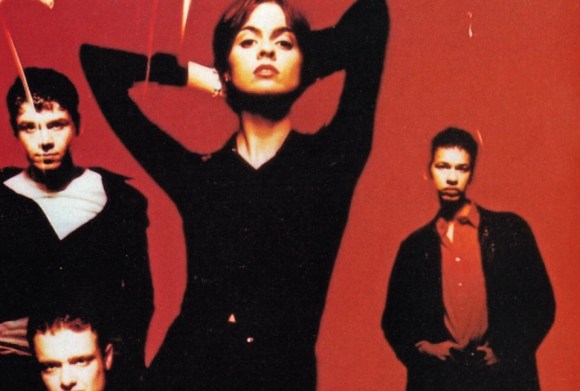
Four tracks in on the soundtrack is this cover of the Blondie track “Atomic”, done by a perhaps lesser-known** Britpop act named Sleeper . Unless I am mistaken, this was the very song that was playing during the scene in which Ewan McGregor’s character, Renton is at a club with his friends and he first catches sight of Kelly Macdonald’s character, Diane***. I won’t go any further lest I ruin part of the story for any of you yet to see the film but I will say that this song was seared into me and became one that I would play over and over again.

I had actually gotten into the band already with their debut album, “Smart”, released the previous year, and with “Atomic” fitting right in with their sound, I didn’t immediately realize it was a cover. When I did and tracked down the Blondie original****, I was somewhat tickled at how faithful a cover it was. It was as if the filmmakers wanted to include the original but somehow couldn’t get the rights and found some other band to replicate it almost to a tee. Admittedly, Louise Wener is not Debbie Harry, nowhere near comparable in the vocal category, but otherwise, I’d have a hell of a time telling the music apart.

Blondie fans might call this one sacrilege but I’d call this comparison even and given my fondness for Britpop, I might even give the Sleeper version the edge.

Cover:

The original:

*Or maybe just me.

**Although at the time, they were quite well-known, scoring a good number of hit UK singles.

***I also had taped to that same residence wall a picture torn from a Select magazine of Sleeper front woman Louise Wener dressed and mimicking the likeness of Diane from the Trainspotting promo shots.

****One of its many versions.

For the rest of the 100 best covers list, click here.

Categories
Tunes

100 best covers: #58 Sarah McLachlan “Blackbird”

<< #59    |    #57 >>

Way back at number 90 on this list, I wrote about Rufus Wainwright’s cover of “Across the universe” for the soundtrack of the Sean Penn film, “I am Sam”. Now, more than thirty songs later on this 100 best covers list, we have another Canadian artist covering another Beatles track off the very same soundtrack.

The music for “I am Sam” was supposed to reflect the title character’s love for Beatles music, a sort of crutch for an intellectually disabled man fighting for custody of a daughter, named, get this, Lucy. The original Beatles songs were chosen while filming was taking place so when the filmmakers were refused the rights to those originals, covers were commissioned that had to retain the same track length and time signatures.

The Paul McCartney penned “Blackbird”, a gentle acoustic piece about US racial tensions off The white album, was assigned to Canadian singer/writer, Sarah McLachlan. It was recorded right in the middle of a six year break between her very successful 1997 record “Surfacing” and the 2003 ‘comeback’ album, “Afterglow”. I honestly don’t know how well McLachlan does outside of Canada but here at home, she is pretty legendary. And why not? That voice of hers is golden. She made a career out being a solo, folk-influenced female artist in a time when male-dominated grunge was king. She started the Lilith fair touring festival in 1996, a card that prominently featured female solo artists or female-led bands and was so successful that two more annual editions followed. I’ve never been a huge fan of her myself, but you can’t argue with her talent and her success.

Much like the stripped down original, Sarah McLahlan’s cover is built upon beautiful finger plucking on the acoustic and yeah, that wonderful voice of hers. It is quite simply a lovely rendition. Do I like it better than the original? No. However, I do find it a shade better than the one done by Doves (who you all know that I love) for the Roswell soundtrack. So yeah, I think that’s saying something.

Cover:

The original:

For the rest of the 100 best covers list, click here.

Categories
Tunes

100 best covers: #64 The Boo Radleys “There she goes”

<< #65    |    #63 >>

While looking for something to listen to on Spotify recently, I rediscovered that Alan Cross’s amazing radio show, “The ongoing history of new music”, is available on there as a podcast. I may be one of the only people that I know that never got into the concept of podcasts, always preferring to listen to music whenever the opportunity is afforded to listen to something, whether it be in the car, at work, or just puttering around the house. However, I always loved listening to Alan Cross’s radio show back when I was younger and living in Toronto, where his show was originally broadcasted on CFNY, and I decided to give the podcast a try. I’ve now listened to and enjoyed a few episodes (of course, Cross is still as interesting and engaging as ever) and can now see myself checking it out on the regular.

I mention this because in a weird coincidence the theme on the very first podcast episode to which I listened had for its theme, one-hit wonders of the 1990s, and in the middle of the show, Cross called The La’s’ “There she goes”, ‘the perfect pop song’. I myself included this very track and ranked it number one when I did a post on my top five one-hit wonders of the 1980s* a few years ago. In that post, I also referred to it as a perfect pop song, to the ‘jangly guitars that shimmer in the sunlight’ and how ‘Lee Mavers’ vocals alternate between rough and soft’.

This balance and counterpoint and the compact song structure and length is likely why so many artists have covered it and have had success with it. Indeed, “There she goes” has been covered by The Wombats, Robbie Williams, and by an American a cappella act called The Kingsmen. Perhaps most famously, Sixpence None The Richer covered it and released it as the second single off their self-titled album in 1999, the follow up to the ubiquitous hit, “Kiss me”. Their slowed down, acoustic focused version did quite well and sure, it’s lovely enough, but in my opinion, it completely dispenses with any of the edge on the original.

The cover version that I prefer is the one by British contemporaries, The Boo Radleys, and this can be attributed to the fact that I discovered it at the same time and place as I did the original. Both versions are featured on the soundtrack for the film, “So I married an axe murderer”** and the two together are, in a sense, a de fact theme song for the film. They book-end the album, the cover opening the proceedings and the original having the final word. I used to think they were pretty much the same but on closer inspection recently, I managed to separate the intricacies.

The Boo Radleys ease off a bit on the jangle by replacing the iconic arpeggio guitar intro with horns and they unbelievably one-up the original in peppiness by increasing the tempo, adding handclaps, and vocal harmonies. In another ‘how did they do it’ facet, The Boo Radleys’ version even managed to come out thirty seconds shorter than Lee Mavers’ perfect pop song length in the original.

Is the cover better? You won’t catch me answering the affirmative here – the original is so good – but I do enjoy both.

Thoughts?

Cover:

The original:

*”There she goes” was originally released as a single in 1988 but was re-released a couple of times in the 1990s. Hence, it being attributed to both the 1980s and the 1990s.
**It’s a great soundtrack, much better than the film for which it was put together. For a bit more on both, have a peek on my post on Suede’s “My insatiable one”, another track that appeared on the soundtrack.

For the rest of the 100 best covers list, click here.