“’Cause what the world needs now
Is another folk singer
Like I need a hole in my head”
If you’re like me, you laugh a little bit every time you hear that name-making chorus line by American alt-rockers Cracker. In fact, you probably know many of the great lines in the song so well that you let loose a chuckle a few times during its entirety, even before the words are sung.
“Teen angst (what the world needs now)” was the first single ever released by the band and is track one on their self-titled debut album. Cracker was formed by David Lowery and childhood friend Johnny Hickman in 1990 after Lowery’s first band, Camper Van Beethoven, called it quits. They have released eight more albums since their debut announced their arrival, the most recent coming five years ago and according to my own city’s concert listings, Cracker are still touring, hitting a few North American spots nearing the end of this year. I never got into the Camper Van, myself, nor have I listened to much Cracker since the mid-1990s but I did love their first two records. In fact, while re-listening to “Cracker” while writing this post, I found myself wondering how me and the band ever grew apart and made the decision to have a meander through their latter works.
This particular song, though, with its tongue-in-cheek and self-deprecating attitudes, spoke to people (including myself) back in 1992. It rocked and rolled and thrashed about and twanged its way to the top of the modern rock singles charts. Lowery’s delivery, which cavorted between laidback and morally indignant, was just the right tone at just the right time. He was telling us, even as he was doubting it himself, what he thought the world needed, or maybe just what he needed to survive this world. And well, I agreed with him on many of those points.
For the rest of the Best tunes of 1992 list, click here.
Dada was a nonsensical modernist artist movement that occurred early on in the 20th century. I remember learning about it during the art history segments of my visual art electives back in high school. To be honest, though, it wasn’t my thing. I always preferred the Impressionists, to which these Dada artists were partially reacting.
Dada is also the name of a three-piece alternative rock band from California. Unfortunately, I know less about the band than I do the art movement. In fact, this case is much like the last post in this series, where the tune about which I am writing is the only song I knew by the band for years, except here, I have yet to explore Dada’s catalogue of tunes any further.
“Dizz knee land” was the band’s first single and luckily/unluckily for them, it was huge, easily outselling and outshining anything else they would ever produce thereafter. It was on constant rotation on my local alternative radio station, which is where I first heard it, and I later put it on a mixed tape I was making at a friend’s house with her CD collection (same university friend from that previous post). “Dizz knee land” would go on to help Dada’s debut album, “Puzzle”, sell more than half a million copies and spend a few weeks loitering on the Billboard charts. The band released four more albums over the years, the most recent of which came out in 2004, and save for a hiatus between 1999 and 2003, is still officially kicking around.
Our song today is a fun one, as you can tell by its title (the misspelling likely being a way to avoid legal wranglings). It begins with a chiming guitar lick that carries on through the song, dragging with it the vocal melody, then, a drum fill, and we’re off on Michael Gurley’s litany play on the Super Bowl Disneyland commercials.
I just ran away from home
Now I’m going to Dizz Knee Land
I just crashed my car again
Now I’m going to Dizz Knee Land
I just robbed a grocery store
I’m going to Dizz Knee Land
And I just flipped off President George
I’m going to Dizz Knee Land
You get the idea. Funny thing is, and I learned this after years of listening to this tune, going to Disneyland is also used in some circles as a euphemism for going to prison. Changes the meaning, somewhat, doesn’t it?
For the rest of the Best tunes of 1992 list, click here.
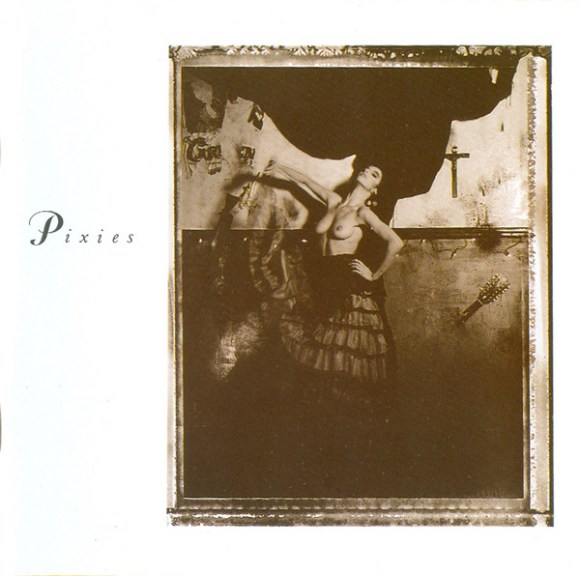
It was my friend Tim that introduced me to the Pixies, though I didn’t get them right away. They were just so radically different from the AM radio I was still transitioning from at the start of the 1990s. But he definitely tried. Every mixed cassette tape I got from his direction included a Pixies track (along with a Mission and a Sisters track, but those are other stories) so I got used to seeing their name. One Friday night, during my weekly ritual of watching and recording music videos off MuchMusic’s City Limits, I pressed the Record button and added the video for “Alec Eiffel” to my collection. It was this knee jerk reaction to a band name I recognized that became my gateway to the now legendary quartet from Boston.
I shortly thereafter bought a used copy of their second long player, “Doolittle”, which I now love unconditionally. However, the debut album took me much longer to appreciate. Perhaps even a decade, I couldn’t tell you now how long I held out but it all seems silly now, given that I hold all four of their original albums with such reverence. “Surfer rosa”, though, was a game changer. David Lovering, Kim Deal, Joey Santiago, and Black Francis let their don’t give a shit attitudes carry over from from their first ever recorded release, the mini-album “Come on pilgrim”, mixing punk, surf-rock, and whatever else they pleased into their incendiary noise. It is seen as a template for what 90s alt-rock would eventually become, not just for the sheer brashness of the music but also its iconoclastic production, netting future jobs for Steve Albini with artists like PJ Harvey and Nirvana.
So for an album that didn’t sell particularly well (taking decades to reach gold status), it is quite an influential one and one that sits high on many best rock album lists, even winning over many of the critics that didn’t quite get it at the time. And though the whole album has become ingrained in my musical fabric, I still have my favourites and I’ve included them here in my three picks for you.
”Bone machine”: “This is a song for Carol.” Except that it’s not, it’s really a song about sexual deviancy in a few forms. Namely, molestation by priests (“I was talking to preachy-preach about kissy-kiss”) and infidelity and possibly, nymphomania (“Your blistered lips have got a kiss, they taste a bit like everyone”). The opening track on the album, “Bone machine”, is discordance personified, pummelling drums, punished guitar strings, screaming and yelping and carrying on. And then, they just pause everything while Black and Deal harmonize sweetly together: “Your bone’s got a little machine.” Oh, the Pixies.
”Gigantic”: “Gigantic” was the only single to be released off the album and happens to be the second longest track on an album of short bursts of adrenaline. It was one of only two tracks not sung by Black Francis in all of the Pixies’ catalogue and bassist Kim Deal, who did sing it, also co-wrote it with Francis. It is also remarkable for its muscular and big bass line that sets the tone and feel. Deal’s vocals are a case in contrasts, see-sawing between soft and delicate and violent rage, especially when she is joined by Francis at the choruses. Everything I’ve read suggests the song is about a married women watching a teenaged black man making love to another woman and fantasizing that it is happening to her. “Gigantic, gigantic, gigantic / A big, big love.” No, their lyrics aren’t irreverent at all.
”Where is my mind?”: If it wasn’t iconic beforehand, it definitely was after it was used to soundtrack the final moments of 1999’s “Fight club”. Indeed, “Where is my mind?” was never released as a single and yet it is considered one of the band’s best known songs. Francis has said that the song was inspired by a scuba diving experience but true to form, there definitely seems to be a lot more going on here than just talking to fish under water. It’s all very surreal and confusing and the music doesn’t help to steady the ship. Discordant (there’s that adjective again) and topsy-turvy, Santiago’s electric guitar line rolls over and over like crashing waves while the acoustic guitar stands timidly in its shadow. Lovering’s drum is big and sparse while Francis’s vocals range from soft coos to yells and yelps and Deal adds her echoing howl throughout. Wonderful stuff.
Check back next Thursday for album #3. In the meantime, here are the previous albums in this list:


 My (life in) music lists