I’d like to say that I’ve been a fan of Elbow since the beginning but that wouldn’t be technically accurate. The band has been around since 1990 or 1991, albeit under a different name up to 1997 when they adopted their current moniker. I can say, however, that I caught on to their debut album, “Asleep in the back”, shortly after its release in 2001. (Yes, it took them that long to finally get a record out but that’s another story.) The album quickly became a favourite, spent months in my CD carousel, and I would name-drop them as often as possible when talking music with friends. It got so that it was a running joke. But I couldn’t help it. I just couldn’t get enough of this band’s dense atmospheric sound, all anchored by Guy Garvey’s unique, emotive vocals. They were like nothing else out there at the time. I once tried finding a comparison point and the best I could do was put Peter Gabriel in charge of a more-orchestral oriented Coldplay or Gene but even that seemed like I was trying to force it too much. My crush on Elbow only grew over time, as with each consecutive album their sound grew lusher and more complex, and they veered further and further away from those tropes that defined the traditional rock and roll band.
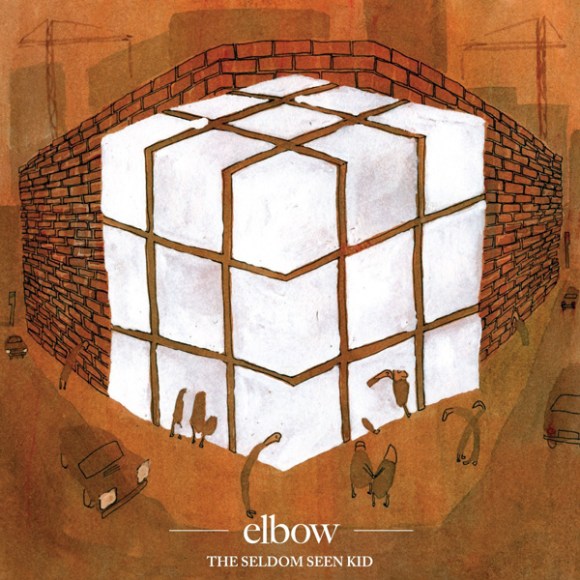
Elbow’s “The seldom seen kid” is the band’s fourth studio album and first on the Fiction records imprint. The album won the 2008 Mercury prize, an honour that the debut was nominated for but did not win. It certainly was up there with the debut as one of my own favourite of Elbow’s albums up to that point, setting a high water mark that its successor, 2011’s “Build a rocket boys!” couldn’t possibly reach.
‘Beauty’ or ‘beautiful’ are terms that are often inaccurately ascribed to music and are terms that shouldn’t be used lightly. But in Elbow’s case, ‘beauty’ is the most apt term I can think of and it could easily be the name of their particular style of music. “The seldom seen kid”, like Elbow’s other albums, doesn’t just create at an atmospheric sound, but whole worlds for you to inhabit, to live and laugh and cry in, as one song bleeds into the next. Each song is painstakingly arranged, the opulent instrumentation acting like a protective carriage to its soul: Garvey’s voice.
If you’ve never listened to Elbow before, “The seldom seen kid” would be a wonderful place to start. Don’t know where to begin? I’d say at the beginning but failing that, here are my three picks for you to sample.
”The fix”: “The fix is in. The odds that I got were delicious. The fix is in. The jockey is cocky and vicious.” This track has the added bonus of being touched by the hand of another talented musician with immediately recognizable vocals: Richard Hawley. His rich baritone vocals jive perfectly with Garvey’s, either while trading coyly or while in pleasant harmony. It is a slinky piece, obviously influenced by Hawley’s mere presence and his penchant for gleefully old-school sounds, tempered with his golden work on guitars.
”Grounds for divorce”: “There’s a hole in my neighbourhood, down which of late I cannot help but fall.” With a song title like this, it’s fitting that the song plays like one a chain gang might sing. From the marching drum beat to the call and response vocals in the intro to the dirty, southern bass line throughout, Garvey us leads through a rousing romp that is guaranteed to get you stomping.
”One day like this”: “So throw those curtains wide, one day like this a year would see me right.” With six and a half minutes of string flourishes, peppy beats, and uplifting vocal twists and turns, this song makes an ambitious bid for the title of my favourite Elbow track. It’s just one of those songs for which the volume can never be turned up quite enough. While listening to it, you want its blissful ecstasy to fill every crevice of your hearing, to blot the sounds of your humdrum day. You want to join in on the singalong refrain that carries on through the last half of the song with the thought that maybe tomorrow will be that day. Yup. Beautiful.
Check back next Thursday for album #4. In the meantime, here are the previous albums in this list:
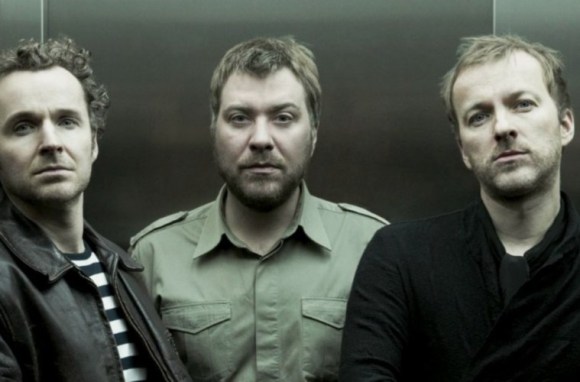
Band members: Jimi Goodwin (lead vocals, bass, guitars)
Jez Williams (guitar, vocals)
Andy Williams (drums, vocals)
Discography:
Lost souls (2000)
The last broadcast (2002)
Some cities (2005)
Kingdom of rust (2009)
Context: Doves have been front of mind recently for me because the slew of us that consider ourselves fans got an early Christmas present at the beginning of last month when news came down the pipe that the band was reforming. Interestingly, they never really broke up. The official word back in 2010 was hiatus. However, it was a hiatus that seemed interminable and the good but not Doves great solo and side project albums that appeared from its members only exacerbated our collective impatience. Recently, someone started an online petition to get them back together and that really gained steam – it had a Twitter account and everything. And now, they’re back… but what that fully means is still a bit unclear. A handful of gigs in their native England have been planned and announced, with more promised, and rehearsals have started in earnest. At the time of writing this, we still don’t know if there will be tours outside of England, a new album, or vinyl reissues of their now classic back catalogue but one can hope that this reformation isn’t temporary.
Doves originally formed with their current lineup as Sub Sub in 1991. Jimi Goodwin met twin brothers Jez and Andy Williams at high school in Wilmslow, a town just south of Manchester, England. Sub Sub came about after they got reacquainted at the Haçienda and they released a bunch of singles and EPs through the 1990s on Rob Gretton’s record label. A fire at the band’s studio in 1996 meant they lost pretty much all their equipment and recordings and this inspired them to change gears and name. Doves’ atmospheric alt-rock was an obvious departure from the house and dance of Sub Sub when it appeared in the form of an EP in 1998. A couple more of these followed before their debut full-length appeared in 2000. Regular readers of this site might recall that a couple of songs from “Lost souls” appeared on my best tunes of 2000 list.
However, that album wasn’t my introduction to the group. It was “The last broadcast” that first caught my ear. I fell in love with that album on one of my many trips down to Toronto in the early days of living in Ottawa, back when our only mode of transport to home and back was by Greyhound bus. That particular ride was the overnighter on the Friday of the August long weekend. I had the album on repeat on my Discman for the entire five plus hours trek and it kept me company as I wavered in and out of sleep, ingraining itself into my subconscious. After that, “Lost souls” became my friend as well and each successive album became an anticipated event.
Doves released only four albums in total, all of them in the 2000s, before their hiatus took hold. Each of these is a favourite of mine and hence, each has its place near the top of my list of best albums for the years in which they were released. And given the appetite for their reformation, I’m pretty sure I’m not the only one who feels this way. For me, it was a difficult task to choose only five great tunes from their catalogue, but I did manage to represent each of the band’s four long players. And I want to state now that I reserve the right to revisit this list in the future, should this reformation lead to new material because I am sure they’ve got same amazing new music left in them, just waiting to be unleashed on us. Here’s hoping, right fellow fans?
In the meantime, have a perusal of the songs below and as always, let me know your favourite Doves tunes. I’m always willing talk this band.
The top five:
#5: Walk in fire (from “Some cities”, 2005)
Kicking things off with song number five, it is a tune never released as a single from Doves’ third studio album, “Some cities”. This was the first album released after I had discovered them so it was also the first album that I had heaped expectations upon. This anticipation led to an initial letdown for me, the only time I experienced such a feeling with any of their albums. In fact, “Walk in fire” was an early favourite because it most closely resembled the work on “The last broadcast”. The rest of the album and its “stripped-down” approach has since grown on me but this one still remains the standout. It’s a song that builds over its five and a half minutes, which is something you might hear over and over again for these five tunes. Starting with a creak and a sigh, an arpeggio on the chiming guitars, and Goodwin wistfully singing about someone you could swear is from his past, or your past, the drums ease in after the first verse and the guitar effects hanging and teasing around thus far increase in insistence. By the time the chorus hits us with that line, “you’re not free till you walk in fire”, things have reached a pretty frantic dance pace. But it doesn’t stop there. Save for a brief respite at the bridge, where things ease off to give space for a lovely echo of keys, Doves keep raising the bar right to the end, stoking the flames to a mass conflagration. All you have to do is walk through it.
#4: Kingdom of rust (from “Kingdom of rust”, 2009)
Our next tune here is the title track and first single off Doves’ fourth and final album, “Kingdom of rust”. It is the second track behind album opener, “Jetstream”, both of which I fell in love with from the beginning. In fact, it took a bit of time to get past these two tunes, they just kept repeating, the rest of the album didn’t reveal itself to me for well over a week after I got it. “Kingdom of rust” is also the only tune by Doves my wife Victoria likes, which still blows my mind. (I obviously need to work harder on her.) I’ve tried to figured why this one particular song appeals to her when the others don’t but the reason eludes me. I’ve thought that perhaps it’s not as fast past paced or busy as some of the others. Yet this is incorrect, the pace is definitely high energy though it feels slightly tempered by Andy Williams opting for brushes over sticks on the skins. And even still, when his brother Jez decides to let loose on his guitar halfway through the song, the sticks return to play and they both unleash a fury. I also wondered if it was the liberal use of a string section, which never really hurts, to Victoria’s ear, though this isn’t the only track on which Doves employ the use of such orchestral sounds. I’m not sure I’ll ever figure it out but it’s a rocking track nonetheless.
#3: Pounding (from “The last broadcast”, 2002)
The second single released off Doves’ second album, “The last broadcast”, certainly lives up to its name. “Pounding” is a case of relentless drumming by Andy Williams. It is a heavy thump thump thump on the bass drum, as inescapable as the passage of time. It is energy and exuberance personified. It is Jimi Goodwin singing about the value of living in the moment and not getting hung up on the unimportant things, singing “I can’t stand by and see you destroyed. I can’t be here and watch you burn up.” It is a leap into hyperspace to chase down enemy tie fighters. It is Jez Williams doing his best The Edge impersonation about halfway through the song, wailing away on his guitar like he still hadn’t found what he was looking for. It is a great driving tune. Nay, I don’t how many times I have cranked the volume on this one in my car and each time the speedometer needle has crept up by itself and I’ve had to lighten my gas pedal foot. If you want a burst of energy and a jolt of good mood, here’s your song.
#2: The man who told everything (from “Lost souls”, 2000)
“The man who told everything” is the third single to be released off “Lost souls” and coincidentally, came in at number three on my best tunes of 2000 list. Forgive me if I plagiarize myself from that earlier post it because, well, I’m not feeling up to reinventing the wheel today. “‘The man who told everything’ is big, bold, and beautiful. But don’t mistake my words for inferring that this tune is high energy frenzy. Instead, for all the excitement of the words, the music has a more muted pace. The guitar strumming matches the easy drumming at the outset but at each chorus, another layer of guitars and string effects is added that has an arduous quality, at once daunting and stubborn and unforgiving. I don’t how to else to describe it. It’s brilliant though. I like to listen to this one late at night, lights dimmed, earphones on, volume up, eyes closed, a pint not far from hand, and just let the waves of it all crash over me. So much awesome.”
#1: There goes the fear (from “The last broadcast”, 2002)
Of course, you knew that if the band only had four albums and each was represented, there would have to be an album that was represented twice. And of course, that album would have to have been “The last broadcast”, my introduction to the band, as mentioned above, and my still favourite of their albums. “There goes the fear” was the first single released from the album and was one of those that was deleted on the same day it was released so only a lucky few out there have a physical copy of the single. It can more easily be found as track three on “The last broadcast” and is most definitely ranking up there as one of my favourite ever tunes. Yes. Just listen to it. It is nearly seven minutes of pure danceable bliss. The guitar work that strings its way through its entirety reminds me of those old toys that you cranked and it played a tune that could speed up or slow down depending on the speed of your cranking. The drum beat, though not as insistent as on “Pounding”, is no less energizing, almost frenetic, tribal and hypnotic, driving you to the dance floor like an adrenaline surging drug. This song and its slow build of layers, stepping it all up to a point of manic ecstasy is the template for songs on to come on later albums, like “Walk in fire” (see above). But it is almost pure perfection here. I could just listen to it forever.
For other top five lists in this series, click here.
Last week I posted how I discovered the Levellers and the song at number nine on this list (“One way”), all because they had been compared to The Wonder Stuff, and this week, at number eight, we have the band themselves and their hit single “Welcome to the cheap seats”.
It was my friend Elliott that introduced me to The Wonder Stuff, having loaned me their debut album on cassette tape, “The eight legged groove machine”, a few years after it was released in 1988. There was something about it I connected with (more on that another time) and when I learned they had a more recent album to explore, I jumped on it. I brought “Never loved Elvis” home on cassette and immediately after popping it in my stereo, I noted the striking difference in sound from the debut. Instead of short, peppy, and snarling post-punk, we had fiddle-laden folk-rock but yeah, okay, it was still short and peppy and still had its snarling moments. And did I still love it? Oh yes.
I later learned that the change wasn’t as abrupt as all that but an evolution of sorts when I picked up their sophomore, ‘transition’ album “Hup”. The original four piece of Miles Hunt, Malc Treece, Martin Gilks, and Rob “The bass thing” Jones had become five by the third album, after “The bass thing” had left for America after the sophomore, was replaced by Paul Clifford and they added fiddler and multi-instrumentalist Martin Bell. The Wonder Stuff released four albums in total during their original run before splitting up in 1994. I distinctly remember where I was when I heard the news: out camping with the boys, taking down a dead tree with a dull axe and when my friend Tim arrived with the news, it came down post haste. (And it had a few extra hacks in it for good measure.) They have since reformed, dissolved again, and the name resurrected by frontman Miles with a different set of musicians.
But back to 1991 and “Welcome to the cheap seats” – “where your life’s seen through cracked spectacles.”
It’s brief and upbeat but old-school sounding, like a sped-up waltz, filled with anachronisms and metamusic – it’s what me and my English lit friends in university might have pretentiously termed ‘pre-neo-anti-post-postmodernist’. If you have ever seen the official video (if not, you can watch it below), you’d have seen the band dressed in pseudo-Victorian garb, playing their instruments and dancing about an absurd and surrealist set. You’d also have noticed (and if you had a keen ear, you might have noticed anyway) that that is Kirsty MacColl singing backup, lending her lilting vocals as she has with many an artist, most notably, Morrissey, Billy Bragg, and The Pogues. And there’s another guest musician on the song, adding her accordion to the already folk-laden palette: none other than Spriit of the West’s Linda McRae.
So you see why I love this tune yet? Enjoy.
For the rest of the Best tunes of 1991 list, click here.

 My (life in) music lists