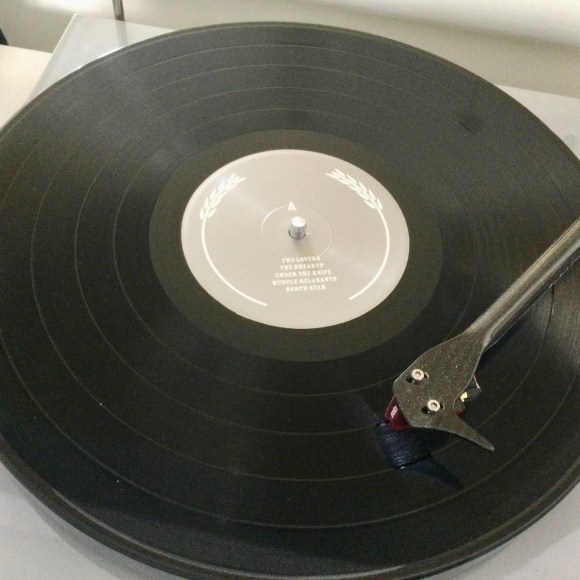
(Vinyl Love is a series of posts that quite simply lists, describes, and displays the pieces in my growing vinyl collection. You can bet that each record was given a spin during the drafting of each corresponding post.)
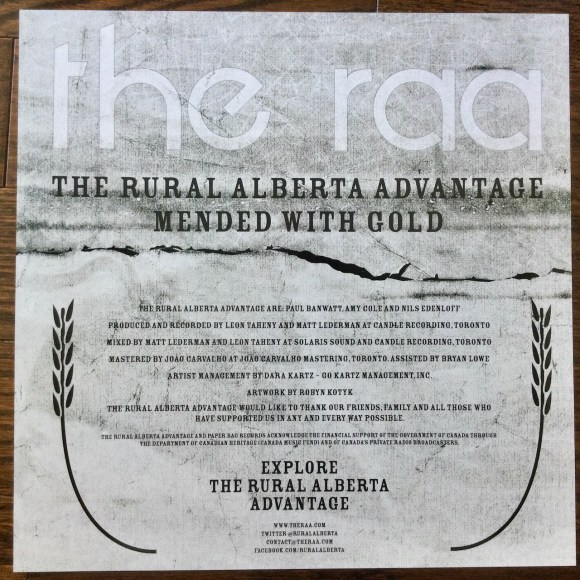
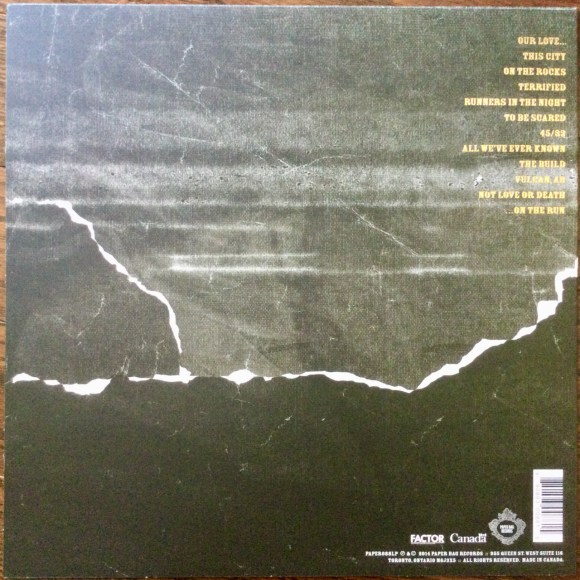
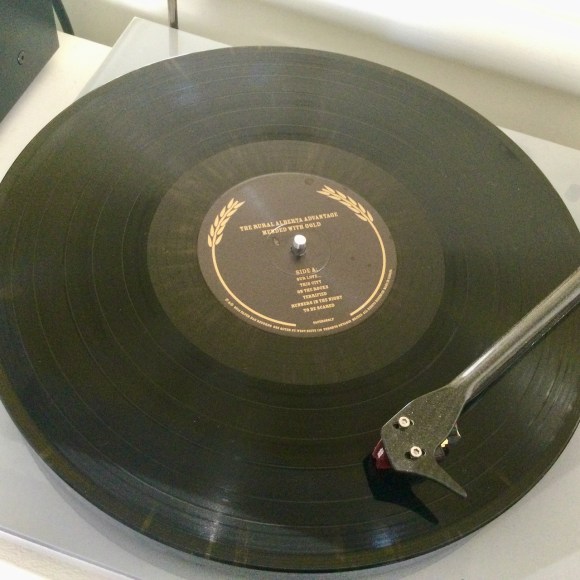
Artist: The Rural Alberta Advantage Album Title: Mended with gold Year released: 2014 Details: Black vinyl with gold flecked splatter, limited to 300
The skinny: Without planning it, I kind of started a mini-series on one of my favourite Canadian indie rock bands, The Rural Alberta Advantage. Over the last two weekends, I have given their first two records, “Hometowns” and “Departing”, the Vinyl Love treatment, mostly because I was in a mood to listen to them, but now that I’ve started, I might as well go the whole way. The Toronto-based trio released their third record on Paper Bag Records in 2011. I somehow missed out on pre-ordering the first pressing in black and gold striped vinyl that was limited to 300 units. Yeah, that one sold out super quick but I managed to get in on the second run, this one also limited to 300 and pressed to what looks at first glance as plain black vinyl, but if you look real close, you catch the glints of flecked gold streaks. And much like the first two, I fell for music on “Mended with gold”, pretty much on first listen. The production on this one is amped right up, giving the trio a real rocking sound, especially showcasing the spellbinding drumming of Paul Banwatt, whose work has always put this band in a class of its own in the indie folk realm.
(Vinyl Love is a series of posts that quite simply lists, describes, and displays the pieces in my growing vinyl collection. You can bet that each record was given a spin during the drafting of each corresponding post.)
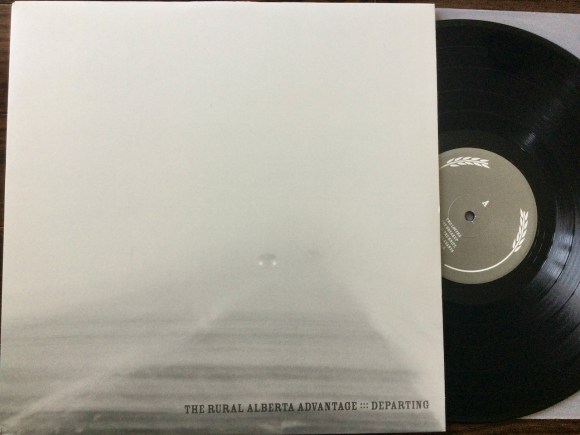
Artist: The Rural Alberta Advantage Album Title: Departing Year released: 2011 Details: Black vinyl, 180 gram
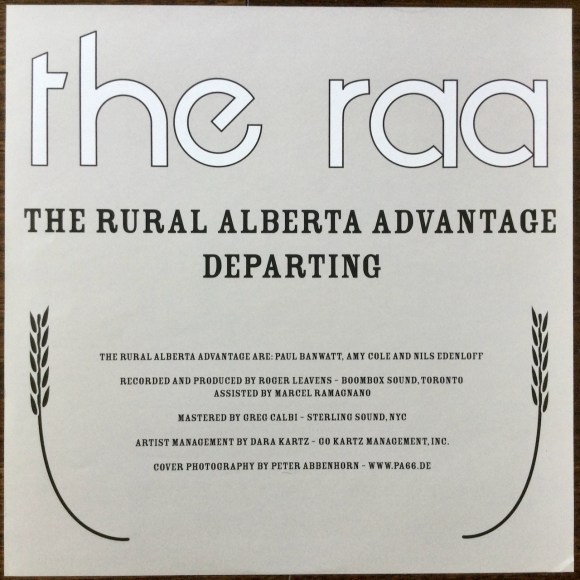
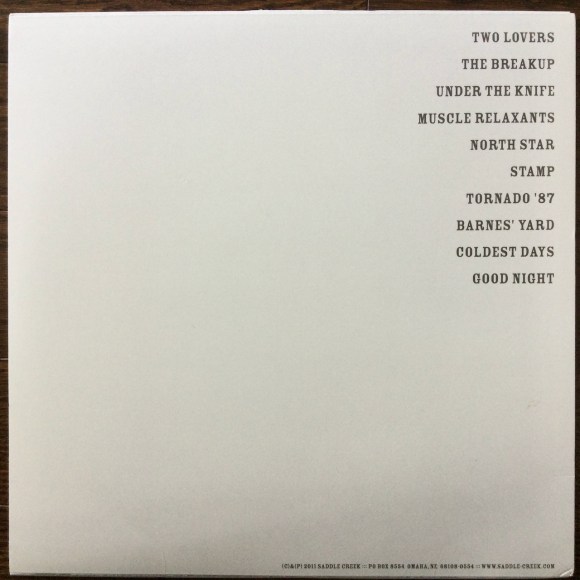
The skinny: The sophomore record by Toronto-based indie folk-rock trio, The Rural Alberta Advantage, was released the year after I discovered them at Ottawa’s Bluesfest and then, fell in love with their debut. “Departing” is the logical next step in the band’s progression so it wasn’t a big leap for me to fall for it as well. The production is crisper and cleaner but it doesn’t take away from the raw energy and crazed percussion that made their first effort so hard to pull away from. Nils Edenloff’s rough hewn sneer is set against Amy Cole’s gentle backing echo, lyrics that paint love stories and memories of home. I only got this 180 gram, original pressing of the record recently, completing my collection of the band’s work (for now). The packaging is very similar aesthetically to the debut (which I featured in last weekend’s post), but the album cover is one of my favourites, a very Canadian image indeed.
Belle and Sebastian were never supposed to be anything more than a project, one that recorded and released a bunch of material in a short period and faded away into the night. They definitely weren’t supposed to be a successful indie pop group that amassed a rabid following on both sides of the Atlantic Ocean and were still releasing new work more than twenty five years in. They started off along the right track, releasing three albums and four EPs in the span of three years but then something happened that derailed their trajectory. I won’t formulate any theories or hazard any guesses but I will say that the result was the group’s fourth long player and everything that happened afterwards.
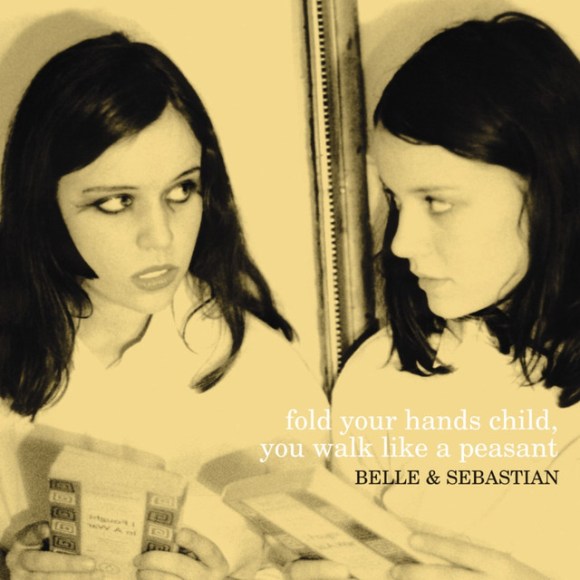
“Fold your hands child, you walk like a peasant” was my first experience with listening to a new Belle and Sebastian album just after it was released. I had gotten into the Scottish collective after had they released their third album, “The boy with the arab strap”, on suggestion from my university friend Darrell, who said you can’t go wrong with any of their releases, just pick one. I went with the green album cover and worked backwards from there. As it turned out, “Fold your hands child” was also the first of their albums that I didn’t take to right away.*
The fourth album’s title was taken from a piece of graffiti that frontman Stuart Murdoch had found scrawled in a university toilet. The front cover is a photo that he took of Icelandic twins, Gyða and Kristín Anna Valtýsdóttir (both from the band Múm), and the back cover is a deconstructed photo of the view from the window of a laundromat he frequented. The music on the album, though, was not all Stuart. Indeed, it furthered the trend first brokered on “The boy with the arab strap” of more collaboration within the group, shared songwriting and vocal duties. The recording sessions were difficult and took longer than previous ones, which Murdoch attributes to the darker tone and more complex arrangements and song structures. Murdoch has said the album reflects perfectly what the band’s life was like at that point in time and changed everything going forward. It was the last one that featured founding bassist Stuart David and the second last to feature Isobel Campbell.
“Fold your hands child, you walk like a peasant” still isn’t my favourite album by the group but that doesn’t make it bad at all. In fact, I have grown to appreciate it and it now holds a very special place in my heart. Each of its eleven songs brings back a flood of memories, especially the three I have picked for you to sample.
”The chalet lines”: Talk about dark. Songs don’t get much more depressing than this one, nor can you find opening lines more attention grabbing than: “He raped me in the chalet lines”. Stuart Murdoch’s voice and the soft way he uses it to say those words and of course, the tentative piano notes in the opening, pretty much set the tone and signal this to be a real feel bad story. It was inspired by the experiences of an acquaintance of Murdoch’s at a type of holiday camp where the “chalets” are laid out in a row, the very same type of which was where he met the Icelandic twin sisters that grace the album’s cover during a music festival party. The protagonist was raped during such a party at the camp where she worked and she struggles with feeling different now than her friends, not being understood, not reporting the offence, and worrying that she had gotten pregnant. The minimalism – voice, piano, and plaintive cello – and the imagery (“Her face was just a smear on the pane”) do plenty to keep the two and a half minute dirge from taking a detour into sentimentality.
”The model”: Track two on the album is a real danceable number, the kind where you close your eyes and flail about with abandon and a lack of grace. In this way, it reminds me of my favourite B&S number, the title track off the previous album, and much like that one, the words are a litany, a stream of consciousness, a story within a story within a story. But here, in amongst the harpsichord backbone and flute and horn flourishes, one may find slightly more complexities and melodies and tighter pop sensibilities. On vocals, Murdoch relinquishes total control, allowing Stevie Jackson to voice four of the forty lines, the sixth line of every stanza. This jogs the head a bit, suggesting a different point or interjection, playing with the reliability of the confession. Perhaps it’s not just a simple pop song, then? With this lot, it never is. “But you wouldn’t laugh at all and I wonder what the boy was thinking. The picture was an old collage of something classical, the model with a tragic air.”
”I fought in a war”: My final pick for you is the opening track on the album, a song, in my opinion, which is the one with the closest resemblance to the work on their earlier albums. And given that it was the first song I heard upon my first go through the album, it was instantly recognizable and in this way, feels like the group’s technique of weening its fans from everything that came before. But even here, the subject matter is darker, the tone heavy, a weight on the breezy melody and the bright horn blares. Beware, though, don’t get taken in by the title and lyrics and fall into the open trap left by Murdoch into thinking this a protest song. He has said that it is in fact inspired by a Salinger story, “For Esmé – with love and squalor”, one that I read ages by sadly, don’t exactly remember so I may have to re-read. I imagine though it might be about a lost love, given the metaphorical imagery of the song. “And I reminded myself of the looks you gave when we were getting on, and I bet you’re making shells back home for a steady man to wear round his neck, well it won’t hurt to think of you as if you’re waiting for this letter to arrive because I’ll be here quite a while.” Lovely stuff.
*And from what I’ve read by the critics and the like, I don’t think I was the only one.
Check back two Thursdays from today for album #4. In the meantime, here are the previous albums in this list:



 My (life in) music lists