
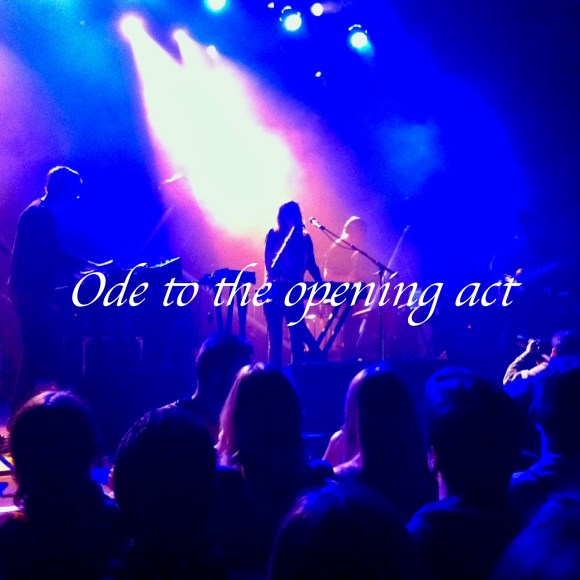
The lot of the opening act is a tough gig.
On the one hand, travelling with an established band, especially one of similar aesthetic, can bring a new or lesser known musician or band some much needed exposure. On the other, if it’s not thought through, the results can be disastrous and ego-battering. I’ve heard stories of great and talented artists booed, heckled, and worse, made the targets of beer bottle tossing. There have also been cases where bands of mutual respect have decided to team up for a tour, leaving their collective fan bases somewhat confused and terribly mixed, and yes, I’m thinking here of a certain Public Enemy/Sisters of Mercy tour back at the beginning of the 1990s.
Far too often, though, these hardworking and earnest opening acts are simply ignored. Audience members will show up late, often in the middle of the set, choosing instead to pre-drink at a nearby waterhole rather than pay the often exorbitant fees at the concert venue. Or these same folks will show up early with their general admission tickets to carve out a sweet spot right at the front of the stage for the headlining act and rudely spend the whole opening set talking loudly with their friends. I’m not sure which would be worse, though, an empty room or a simply disinterested one.
I always try to make it a point to head out to the show early to catch and show support for these opening acts. There have been times, of course, where the openers have not been my cup of tea and I just focused on drinking (and spending) more. However, I’ve more often than not enjoyed these sets. In fact, I’ve discovered many a new favourite amongst these support acts.
So yes, this month’s playlist goes out to all those opening acts out there. It is twenty songs by bands I’ve seen in the early slot in my many years of concert going. To be fair and to limit things some, I’ve not included any bands that I’ve seen in lower card time slots or on side stages at festivals, though there have been many of these as well. For each act in this list, I’ve provided the date of the show and the headliner, some sentences of context, and where possible, chose a song from that time period. As you’ll see, there are bands that made of me a bigger fan with their set, some that were brand new to me and won me over, and others that actually drew me to the show more than the headlining set. Some of these bands are huge now and some even became bigger names than the ones they were supporting. Check it out.
1. Chapterhouse “She’s a vision”
Opened for The Wonder Stuff, February 20, 1994: When I arrived at the tiny Toronto venue to see my favourite band at the time for a measly $10, I was surprised to learn that many of the people I was meeting at the show were more excited for the opening band that I was considering a bonus. Let’s just say that when Chapterhouse, with whose albums I was already familiar, hit the stage, I was mesmerized.
2. Primal Scream “Rocks”
Opened for Depeche Mode, June 20, 1994: This one’s a bit of a cheat because both the Primals and Mode were preceded by Stabbing Westward, who was to be honest, a yawn. However, Primal Scream and their 1991 album, “Screamadelica”, were what finally drew me to see Depeche Mode live and incidentally, it was the first concert I went to with my future wife, Victoria. Were the Primals great live? You betcha!
3. Weezer “Undone (The sweater song)”
Opened for Lush, August 21, 1994: The song chosen is the one song I had only barely heard before seeing Weezer, who would later become a household name, open for Lush, an iconic shoegaze band remembered now in just a few circles. They were really fun, yet I think I was the only one amongst my friends who was really paying them any attention.
4. Pulp “Do you remember the first time?”
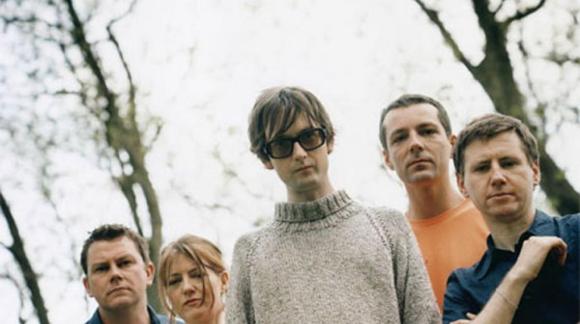
Opened for Blur, September 28, 1994: None of us had really heard much from Pulp before that show but the very next day, it seemed, my friends and I all went out and bought “His ‘n’ hers”. Frontman Jarvis Cocker was engaging, charismatic, and exciting, while the rest of the band, well, they collectively blew our minds.
5. The Dandy Warhols “Not if you were the last junkie on earth”
Opened for The Charlatans, September 26, 1997: The Dandys were another band by whom I was only barely familiar with the one song (again, the one chosen) before seeing them live. Victoria was unimpressed but I loved them and purchased their next release, “Thirteen tales from urban bohemia“ a couple of years later. The rest is history.
6. Spiritualized “I think I’m in love”
Opened for Radiohead, April 12, 1998: These guys are the only reason I’ve ever seen Radiohead live. After seeing Spiritualized blow the doors off a much smaller venue, I just had to see them again when they swung back through town on the same tour, this time warming up a much larger venue for Thom Yorke and the boys. Jason Pierce’s set was great and I was super glad that I stuck around for Radiohead.
7. Billy Bragg “Accident waiting to happen”
Opened for The Lowest of the Low, August 2, 2001: Another cheat because this card was actually led off by Winnipeg’s own, The Weakerthans, but I’m giving Bragg the nod here for returning after his set to perform the song included on this playlist with headliners, The Lowest of the Low. It was fun watching the local heroes falling over themselves and going fanboy over the Bard of Barking.
8. The Sid Hillman Quartet “No perfect world”
Opened for Neil Halstead, April 20, 2002: It was weird seeing Slowdive and Mojave 3 frontman, Neil Halstead, do a show at a tiny, tiny club in Ottawa’s Byward Market but the bigger surprise came when I was even more impressed by the previously unknown to me, alt-country singer/songwriter, Sid Hillman.
9. The Polyphonic Spree “Light & day / Reach for the sun”
Opened for David Bowie, April 2, 2004: We walked into the Corel Centre a little late and found our seats a few songs into the opening set, but the twenty-odd-piece band dressed in flowing robes (that included a harpist, a theremin player, and a choir) certainly made an impression. The very next day at home, I went digging on the internet to track down their debut album.
10. Ambulance LTD “Heavy lifting”
Opened for The Killers, October 9, 2004: There were two bands opening for The Killers at that tiny club in downtown Ottawa but the dream pop/psych rock band from New York definitely made the bigger impression. Ambulance LTD’s self-titled debut has become a favourite of mine from that era. Sadly, they never made another record.
11. Arcade Fire “Rebellion (Lies)”
Opened for U2, November 25, 2005: I finally acquiesced to seeing U2 with my wife when they played a show at the Corel Centre at the behest of friend and then Canadian prime minister, Paul Martin. At that time, it was the most I’d ever paid for a concert ticket but when Montreal’s Arcade Fire were announced as headliner, I stopped complaining. Arcade Fire made a lot of new fans that night in the capital and shortly afterwards, got so big, they were assuming headliner spots at venues of that size.
12. Richard Ashcroft “A song for the lovers”
Opened for Coldplay, March 17, 2006: Much like my Radiohead and Spiritualized story above, I might have never seen Coldplay live if they hadn’t brought Richard Ashcroft along on their X & Y tour. Victoria and I were two of only a few pockets of those standing and singing and dancing along to his whole set amidst a sea ambivalent talkers. He peppered in a bunch of Verve tunes with his solo work but when he played “Bittersweet symphony” as his final song, the rest of the crowd joined us on their feet.
13. The Essex Green “Don’t know why (you stay)”
Opened for Camera Obscura, January 30, 2007: I had never heard this Brooklyn-based indie rock band before the show but based on their performance, bought the CD at the merch table and went back to find their earlier album later on. Unfortunately, they went on hiatus not long after this tour and finally returned last year with a new album that made an appearance on my best of the year list.
14. Young Galaxy “Outside the city”
Opened for The Besnard Lakes, October 13, 2007: This is actually the first of two times I saw Young Galaxy as an opening band (the second time was when they supported Austra in 2011) and I’ve actually seen them two other times live. Indeed, they are one of my favourite ever bands. However, their set supporting The Besnard Lakes seemed perfect, a dream pop/psych rock band doing support for another. Although Young Galaxy moved on to a more electronic sound, this era was my favourite of theirs.
15. Small Sins “We won’t last the winter”
Opened for Secret Machines, November 15, 2008: Small Sins were the short-lived synth pop project of Thomas D’Arcy that released three albums in the late 2000s. D’Arcy later released work under his real name and has found success in production work on some very successful Canadian rock albums. His opening set that night was incredible.
16. I Break Horses “Winter beats”
Opened for M83, May 6, 2012: I’ve already written on these pages about how I Break Horses (pictured above) was the bigger draw for me than M83, for whom they were opening. Well, M83 were eye-opening but the Swedish duo of Maria Lindén and Fredrik Balck didn’t disappoint in the least either.
17. John Grant “Pale green ghosts”
Opened for Elbow, May 17, 2014: I had never heard John Grant before seeing him open for Elbow at the famed Danforth Music Hall but his deep baritone vocals and dramatic presence was certainly a welcome warm up and both my wife and I took notice.
18. Gateway Drugs “Friday’s are for suckers”
Opened for Swervedriver, May 5, 2015: This band of newcomers impressed me enough to pick up their debut album at the merch table, their performance being my first exposure to their dirty and noisy glam rock. Their silence in the years since has been a surprise to me because I was sure they would make a name for themselves but it’s not too late: a sophomore album is forthcoming in October.
19. Tess Parks “Somedays”
Opened for Ride, June 2, 2015: I had to rush the whole lot of friends and friends of friends who had amassed to pre-drink before the first Ride show in Toronto in decades to finish their beers just so I could see her set. Tess Parks was tentative but the strength of her songs carried her. She has since collaborated with Brian Jonestown Massacre’s Anton Newcombe and I expect there’s more good tunes coming from her soon.
20. Japanese Breakfast “Everybody wants to love you”
Opened for Slowdive, May 6, 2017: I was at first quite surprised to see all the young people that were at the Montreal stop on shoegaze legends Slowdive’s tour. But then, it occurred to me that they were probably there to catch buzz act and next gen dreampopper, Japanese Breakfast. I had only given Michelle Zauner’s debut a cursory pre-listen but really enjoyed her set.
Now that you’ve perused and perhaps listened to the embedded playlist below, I’d just like to sum up by saying: Next time you go to a show, remember this playlist and the fact that you might be missing out on your next favourite band. Come out early and join me near the front of the stage. I’ll be there with a beer in hand, trying not to be annoyed by the loud talkers standing in front of me. Cheers.
For those of you who are on Spotify, feel free to look me up. My user name is “jprobichaud911”.
 My (life in) music lists