Categories
Tunes

Best tunes of 2012: #25 Sea Wolf “Priscilla”

<< #26    |    #24 >>

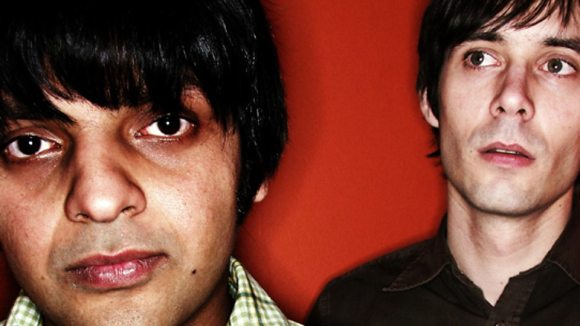
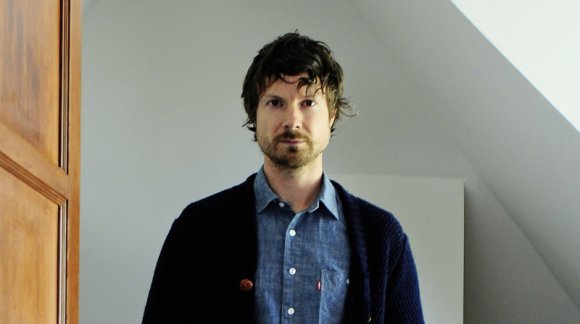
Sea Wolf is an Los Angeles-based indie rock act that is mainly the vehicle for the songwriting of Alex Brown Church. He started the project in 2003 when the songs he was working on while part of the band Irving didn’t fit their sound. In 2012, he released “Old world romance”, the third full-length album to be produced using the Sea Wolf name, and this following on the heels of two previous, relatively successful albums: 2007’s “Leaves on the river” and 2009’s “White water, white bloom”.

As I mentioned above, Sea Wolf is mainly Church’s project and yet “Old world romance” is the first of his albums that was completed without the help of enlisted musicians, recorded all by himself. But instead of feeling like a basement (or living room) DIY project, the album has a crisper and cleaner sounding production than its predecessors and because he used a drum machine rather than a live timekeeper, some of the organic sound has been dispensed with, in favour of a more mechanical effect. I’m not saying this is a bad thing at all. In fact, I think it was this inner struggle that reverberates throughout the album between the traditional, folk stylings and the modern and electronic sounds that caught my attention in the first place. It’s almost a reflection of the man versus nature themes that are hinted at on the album’s cover and are prevalent in the naturalistic novels of Jack London . Yes, in case you Jack London fans were wondering, the band’s name, Sea Wolf, was taken from the novel of the same name.

“Priscilla” is my favourite track on the album. When I first listened to it, it drummed up memories of listening to songs like “Sonnet” and “This time” of The Verve’s “Urban hymns” for the first time. Not necessarily the vocal work, though Church does sound a bit a cross between Richard Ashcroft and Echo & The Bunnymen’s Ian McCulloch, but there is an atmospheric feel to it, naturalistic, much like The Verve’s dense ballads, it makes for heady chill out music. Starting off with reverb guitars that sound like a distress call or echoing birds calling over the bay, then, the drum machine beats crash in like waves and acoustic guitar strumming layers in with synth string washes, all haunting and chilling cold ocean breeze. Watch out. There’s a storm brewing here. The waves are picking up and smashing and pounding the stony shore. Interesting, then, that it’s a song about a relationship on the rocks.

“So Priscilla, this is important
Time to tell us this is
No goodbyes and no time for mourning
Now we’ll see what this love is for.”

Sigh.

For the rest of the Best tunes of 2012 list, click here.
Categories
Tunes

Best tunes of 1992: #12 Lush “For love”

<< #13    |    #11 >>

Having reached my teen years growing up in a small town, wheels became an absolute necessity. I didn’t get my driver’s license until 1992, much later than my other friends, and only because I wanted to beat the implementation of graduated licensing in Ontario, Canada (those from the province of a certain age will know of what I speak). But even after getting my license, there was always the hurdle of convincing my parents to loan me their vehicle for the evening.

Luckily, we had a few friends in our group that had their own car or had no similar difficulties in borrowing one from their parents, and one of these was our friend Tim. Even when he went off to university, he had no problem getting his father’s keys whenever he was back in town for a visit. And though we appreciated being able to get anywhere within driving distance on most nights, it didn’t stop us poking fun at the malfunctioning climate controls or the fact that the fuel gauge was perennially on empty. We never did run out of gas, to everyone’s surprise, and Tim always ended the night by putting $2-3 in the tank to keep the needle just above the red mark.

Of course, there was always great tunes pumping out of the factory-installed speakers on those evenings out on the town. Tim seemed to have a new mix in the cassette deck every single time and though we always jokingly slagged him for his tastes, I was always discovering new bands this way. Which brings us to our song at the number twelve spot on my best tunes of 1992 list.

It was either late November or early December in 1992. It was most definitely a cold evening because I remember Tim having to rub away a small window in the frost that had accumulated on the inside of the windshield. He was back for the weekend from Waterloo university and we were getting into his car after taking in the late showing of “Bram Stoker’s Dracula” at the Whitby cineplex theatre. The heater didn’t seem to be doing anything to warm our bones but thankfully, the stereo was working and as he pulled out of his parking spot, Lush’s “For love” came bursting forth.

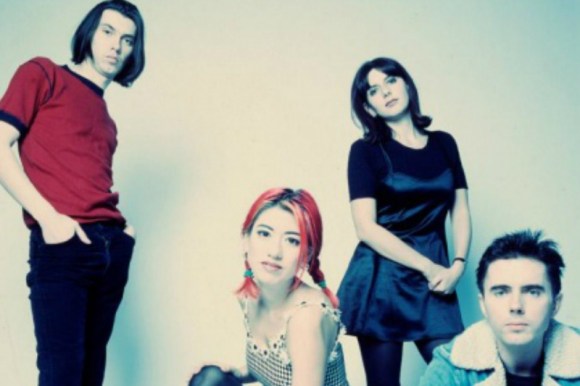
I would later learn that this was the second single to be released off “Spooky”, the London-based quartet’s first proper LP of new material. For this one, the band had enlisted Cocteau Twin’s Robin Guthrie to produce, much as he had on two of their previous EPs. Fans of his band might recognize his influence on the work here, lots of light bounces and sun reflections and haze rather than the noisy guitars of Lush’s shoegazing contemporaries. There was plenty of time for that later.

“For love” is still one of my favourite Lush tracks and not just because it was my first. Just listen to that bass line bopping back and forth like a slinky and those ringing and jangling guitars, sounding like chimes and bells dancing in the wind. And yeah, the dual harmonizing female vocals by Miki Berenyi and Emma Anderson, all breathy and breathless, voices sounding almost like they are singing through flutes. It could be the memory creeping in every time I listen to it but I always get the tingling feeling of a light frost and the twinkling and tinkling of icicles shaking off of fir trees. Beautiful.

For the rest of the Best tunes of 1992 list, click here.

Categories
Tunes

100 best covers: #69 Cornershop “Norwegian wood (This bird has flown)”

<< #70    |    #68 >>

Chances are pretty good that if you haven’t heard tell of Cornershop, you’ve likely heard their huge, worldwide hit, “Brimful of asha”, bolstered in large part by the fabulous remix by Norman “Fatboy Slim” Cook. The original version of that track appeared on Cornershop’s third album, 1997’s “When I was born for the 7th time”. The album was released just past the apex of the Britpop craze and though neither their sound, style, politics, or ethos necessarily matched up with others from the scene, they were still lumped in with that lot simply because they were there. It was likely thanks to their appearance in the British music magazines I was in the habit of purchasing when I had the coin, and the aforementioned ubiquitous hit, that I purchased the album on CD during my final days of university*. And though I did like a lot of its tracks, it took me a few years to really appreciate what Tjinder Singh and Ben Ayres were doing. There was so much going on here – psych, funk, rock, dance, ambient, and traditional Indian music – and the culmination of all this was summed up in this fun cover of The Beatles’ “Norwegian wood (This bird has flown)”.

The original, I’m guessing, needs no introduction. Recorded way back in 1965 for the album “Rubber soul”, “Norwegian wood” is widely considered to be one of the first instances of ‘Raga rock’ and was also highly influential on the burgeoning psych rock movement. The song was written by John Lennon, apparently about an extramarital affair, with contributions from Paul McCartney, its composition inspired by the folk ballads of Bob Dylan. But it all really came together when George Harrison added a touch of sitar, an instrument he had just recently discovered and had started to learn, and all of a sudden, we had our first Western rock song to feature the Indian traditional stringed instrument.

So, in fact, it’s quite compelling that Tjinder Singh, whose band name was a play on the stereotypical vision of Indian immigrants in England, would choose to cover this particular track. Reportedly approved by both Paul McCartney and Yoko Ono, his cover translated the words to Punjabi, upped the sitar focus, and in a sense, whether intended or not, reclaimed the use of the instrument and shone a spotlight on his heritage.

It’s never a fair game to try to rank a cover against a Beatles original but I definitely think Cornershop’s version of this track is worth your time. What are your thoughts?

Cover:

The original:

*”When I was born for the 7th time” eventually wormed its way deeply amongst my favourites of 1997, one of the greatest years for music (in my opinion), and landed on my top ten when I counted them down a couple of years ago.

For the rest of the 100 best covers list, click here.