
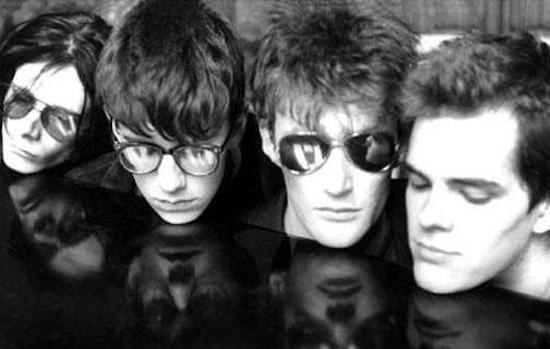
Who? The Sisters of Mercy
Years active: 1980 – present
Band members*:
Andrew Eldritch (lead vocals, keyboards, guitars, drum programming) 1980 – present
Doktor Avalanche (drum machine) 1981 – present
Gary Marx (guitars, vocals) 1980 – 1985
Craig Adams (bass) 1981 – 1985
Wayne Hussey (guitars, backing vocals) 1983 – 1985
Patricia Morrison (bass, backing vocals) 1987 – 1989
Chris Catalyst (guitars, backing vocals) 2005 – present
Ben Christo (guitars, bass, backing vocals) 2006 – present
*The above is only a selected list of band members. There have been a number of members throughout the band’s existence, of which Andrew Eldritch is the only constant.
Discography:
First and last and always (1985)
Floodland (1987)
Vision thing (1990)
Context:
So it’s October and Hallowe’en is just around the corner. I didn’t do anything holiday-themed last year and typically don’t observe the holidays too much on these pages but well… I’m due for another Top Five Tunes post. I thought about doing a Top Five favourite Hallowe’en tune post but didn’t have the energy to dig too deeply into my iTunes collection. Then I thought about going Goth and even that felt like I would have to wrack my brain a bit too much. (You’ll have to bear with me, I’ve already started looking at narrowing down my favourite albums for the end of the year series and it’s taking a lot out of me.) So I settled on making October Sisters of Mercy month this year.
Interestingly, if frontman and driving force behind the group, Andrew Eldritch, ever read these words connecting his group with Hallowe’en and anything remotely goth, he’d likely shudder, scream, and want to scratch my eyes out. He’s never been happy with the label, finding it quite offensive that the genre itself exists and even worse that anyone connects his work with it. I’ll never forget the only time I saw them live, back in 1999, and having noted all the black clothing, dyed hair, and heavy eye makeup in the audience, imagined all the collective jaws dropping in the dark when Eldritch took the stage with bleached blonde hair and a Hawaiian shirt. (If you’re wondering, yeah, it was a freaking awesome show.)
It was my friend Tim that got me into the Sisters of Mercy. He could tell you for sure but I feel like before he sold off his vinyl collection in the early 90s, he had a boatload of their 12″ singles. He started me off by including one of their songs on each of the many mixed tapes he made for me in our last couple of years of high school. But I think the night that really sold them for me was a night he was driving us all home from a drama performance night (yeah, I was a thespian back in high school) and “Ribbons” was blasting in the car. Tim hit a speed bump just as Eldritch was screaming “Incoming” and a good portion of the soft drink I was holding was dumped on whoever was sitting in the back seat behind me. The song stuck. And the rest is history.
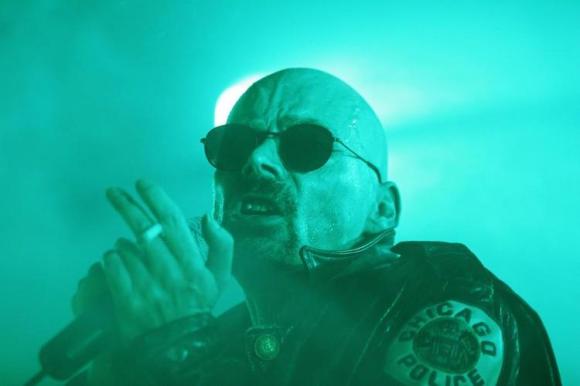
Eldritch formed the group in 1980 with guitarist and friend, Gary Marx, taking their name from a Leonard Cohen song. He started off as drummer but quickly put that aside to concentrate on vocals, replacing himself with the first in a line of many different drum machines, all nicknamed “Doktor Avalanche”, that would provide the group’s rhythm throughout the years. This drum machine would be the only other constant in the group besides Eldritch to this day. You might have noticed above the strange fact for a group that has been in existence for almost 40 years: they’ve released only three studio albums (I’ll get to the why in a minute). But it’s also interesting to note that each of those albums were recorded by an almost completely different group.
After those three iconic records and a bunch of singles and compilation albums, recorded output from the band stopped. The recording hiatus started out as a protest against their record label but East West (Warner) released them from the contract 1997. Still nothing. The touring continued, however, and apparently so did the writing of new material, as was evidenced by the appearance of unreleased songs performed at these shows over the years. Rumours have abounded of new albums in the almost thirty years since “Vision thing” but the closest I think we have come was recently when Eldritch himself posited that they may have to finally get back to the studio should Trump be elected president. Well… the unthinkable has happened, perhaps we’ll see a new Sisters record soon. Until then, these are my own favourites from the old back catalogue.
The top five:
#5: Alice (from “Alice”, 1982)
“Alice” was The Sisters of Mercy’s third ever single but the first to gain any real traction. With its initial release in 1982, it got play on John Peel’s radio show, which led to its re-release the following year on a four song EP. It is one of the group’s best known songs and still regularly appears on set lists. It was re-recorded in 1993 and released as a B-side to the Sisters’ final ever released recording: the single “Under the gun”. Both version are quite good but I actually prefer the more austere and claustrophobic production of the original to crisp and flashy do-over. The song is about drug addiction, the title and name of the protagonist being a nod to the Alice of the children’s stories, and how little else matters to a junkie but the drugs. It is dark, edgy, and haunting, so post-punk and goth, even tending toward industrial before there was such a thing.
#4: Dominion / Mother Russia (from “Floodland”, 1987)
“Dominion” was the second single released off of “Floodland”, which some of you might remember made an appearance on my Best albums of 1987 series that wrapped up last month. Many different versions and remixes of varying lengths have been released but I prefer the seven minute version on the album that includes the “Mother Russia”. It adds a whole other element to the song, with lines comparing the US and Russia, almost equating the two as one. But even without this final piece, the song is very much reminiscent of the Cold War. With the clattering drum ominous guitars, and choral backing vocals, it evokes austerity and totalitarianism and propagandism and the threat of nuclear war. “Some say prayers – I say mine.” Yup.
#3: More (from “Vision thing”, 1990)
This one has already appeared on these pages when it peeked its goth rock face out at number seven on my best tunes of 1990 list last October (coincidence?). It was released as the first single off the outfit’s final studio LP, “Vision thing”, and features heavy handed piano and synth washes, muscular, machine gun guitars, and the backing vocals of Scottish singer Maggie Reilly. Like the rest of their catalogue, it is dark and sinister in sound but if you actually sat down and read the lyrics without the music, you might question it being penned by Andrew Eldritch. It reads like a straightforward love song, albeit one bordering on obsessive, almost junkie territory. “All I want, all I need, all the time is more of your sweet love. Too much just ain’t enough. I never needed a fix like this before.” A great tune for driving in the middle of the night with tears streaming down you face… or… wait… just a great tune, really.
#2: This corrosion (from “Floodland”, 1987)
Recorded during the same sessions as the song at number three above, “This corrosion” has Jim Steinman written all over it. The song is epic big in length, scope, and sound, as well as a budget epic enough to cover forty members of the New York Choral Society, whom you can hear opening the ten plus minute song. It is perhaps The Sisters of Mercy’s best known song, recently appearing in the Simon Pegg comedy, “The World’s End”, and his character sports a Sisters shirt throughout. Given the post-apocalyptic imagery of the video, I used to think there was deep, anti-war message/meaning to the song but I’ve since learned that the song and its “over the top” lyrics are really just a shot ex-band member and The Mission frontman, Wayne Hussey. “I got nothing to say I ain’t said before. I bled all I can, I won’t bleed no more. I don’t need no one to understand.” Learning this hasn’t changed anything for me, it’s still a great song in my books.
#1: Temple of love (1992) (from “A slight case of overbombing”, 1992)
Much like the song at number five, “Temple of love” was an early and popular non-album single that was re-recorded a decade later, but in the case of this song, I prefer the redo over the original. The 1982 version, while excellent as well, is more spare, definitely of its time and place, very much in its post-punk and goth element. Doktor Avalanche’s work here on rhythm is almost too obvious as a machine, the synths and guitars, though dark, are light in comparison with the band’s later work. The remake has the benefit of Andreas Bruhn’s chainsaw guitars and likely more apparent to the listener, the backing vocals of Israel singer, Ofra Haza, who adds a whole other layer of melodic beauty to the song. Doktor Avalanche appears to have learned a thing or two over the years and is more aggressive. The song is long but tailor-made to kicking it up on a Friday night (or a Thursday night pub party) and letting loose all that pent-up anxiety from the week. This song is one that always found me on the stage of the Underground’s dance floor at my own university‘s pub night, dancing with abandon and my pals Sam and Josh, whenever DJ Stephen Rigby thought to put it on, which was practically every week. So much awesome here.
For other top five lists in this series, click here.

 My (life in) music lists