Back in November, I wrote a truly nostalgic post in which I laid out my top five favourite Industrial rock tunes. It was a lot of fun to revisit a genre I hadn’t spent a lot of time with in many years and one that represented for me a specific time and place in my life. All five of the songs were released within the period between the late 80s and early 90s, a specific span of time that I consider to be that genre’s renaissance. Number three on said list was “Juke joint jezebel” by KMFDM, a single off their 1995 album, “Nihil”. It was likely their biggest ever hit but it wasn’t my introduction to the band. No. That came two years earlier with the band’s previous record, “Angst”.
My friend Tim and I were constantly sharing music with each other back in those days. We’d record the entirety of an album on the first side of a C90 cassette and fill the other side with a seemingly random selection of other music, tunes that were tickling our particular fancy at that given moment. “Light” appeared on one of these B-side mixes at some point and it made such an impression upon my teenaged self that it wasn’t long before I was requesting the whole of “Angst” on the A-side of one these cassettes.
This album was a breakout of sorts for KMFDM, who had formed in Germany almost a decade beforehand and had already released six other albums. Their cult following grew into something more when frontman Sascha Konietzko relocated to the United States in the early 90s, bringing the project along with him and attaching themselves to the burgeoning Chicago-based Industrial rock scene and the infamous Wax Trax! Records. “Angst” was the first album recorded completely in the US and involved a lot more guitars in its sound than was present their previous work.
“Light” opens the album with a faint whir, which builds in volume to an explosion of chainsaw guitars. It isn’t the thrash speeds that are heard elsewhere on “Angst”, more mid-weight heavy, restrained for mass coverage, as the song’s title suggests. Nevertheless, “Light” rocks. It never lets up for its six minute duration. A mix of relentless drum machine beats, layers upon layers of guitars and synth darkness. Frontman Konietzko, in his almost self-parodying, militant, German monster growl, lays such lyrical gems on us as: “Deify data, hard but true, Godlike nonsense being thrown at you” and “Take a good plunge and out from the masses, bend over backwards and kick some asses”. Meanwhile, Dutch vocalist Dorona Alberti adds some noir fun with backing vocal interjections, call-and-response-like at the chorus lines.
On the dance floor, “Light” is pure joy, the message and angst secondary to the moment, and at its ending, leaves you completely out of breath and ready for a new beer to refuel.
For the rest of the Best tunes of 1993 list, click here.
Teenage Fanclub is yet another band that I have MuchMusic’s “CityLimits” to thank for the introduction. And I know I’ve written about this very subject many times but it’s true. The late Friday night alternative music video show on Canada’s music channel was instrumental in my education, especially once I had set my sights on music from the left-hand side of the dial. The Fannies video for “Star sign” was what first caught my eye, the jangly psychedelics in sound and image had me tangled immediately and irrevocably in its hypnotic snare. Other videos followed, a few of which are below, and they found themselves on the video cassette tape nets in which I was collecting as much music as I could catch. So when MuchMusic started using the introduction from “The concept” as part the show’s opening, I smiled knowingly every time.
I learned much later that the band formed in 1989 in Bellshill, Scotland. Founding members Gerard Love, Norman Blake, and Raymond McGinley were all talented guitarists, songwriters, and vocalists in their own rights and each contributed mightily to the band’s finished products, especially as time wore on. But even in the case of today’s focus, the incredible third album, “Bandwagonesque”, each member listed above and even the drummer at the time, Brendan O’Hare, had their own written song(s) on the card that the writer sang on the recording and would take up the mike when performed live. (For you Canadian music fans out there, this might remind you of a certain homegrown band of east coast origins by the name of Sloan.) And not only did each sing their own songs but they also found voices on all of the tunes, harmonizing in a way that some might compare to The Beach Boys but those in the real know might liken to Big Star*.
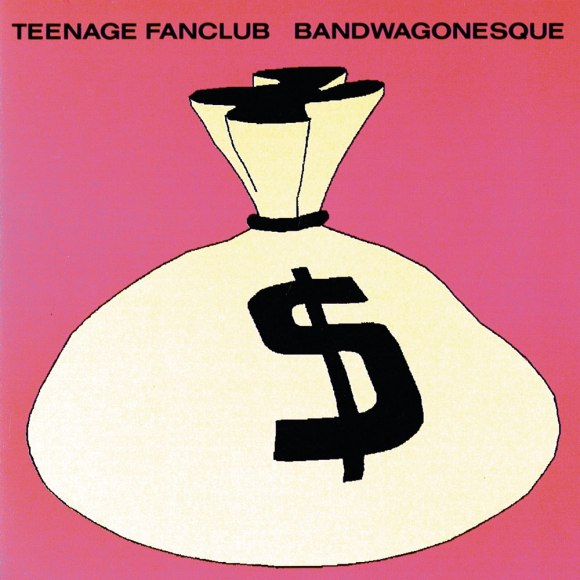
“Bandwagonesque” was a huge leap for the quartet. Their two previous outings were practically throwaways, in-jokes and shambolic cacophonies. In fact, their sophomore album, “The king”, was hastily recorded and deleted from circulation the day after it was released. And the though the third album was still comical and taking humorous kicks at the music industry (just take a look at the name and album cover**), it shows hints at the maturity, musicianship, and longevity of group that still releases music to this day.
The album actually did just as well in North America as it did in Europe and Britain, a feat they were never able to repeat. Many of its singles hit it big on college radio and some even managed to latch on to the newly established Billboard modern rock chart. Indeed, “Bandwagonesque” placed highly on a great many music magazines’ end of year lists, famous placing number one on Spin Magazine’s list over “Nevermind”, “Out of time”, and “Loveless”. I can’t say I disagree with Spin’s assessment (though I am sure in hindsight their pick would be changed), as wouldn’t a bunch of artists that were influenced by the group, like Death Cab for Cutie’s Ben Gibbard, who released a cover of this complete album back in 2017.
My three picks for you from “Bandwagonesque” are all songs with which I fell in love through repeated plays of their videos but really, each of the eleven tracks on the album are pure noise rock perfection. If you’ve seen the cover and heard the name but never taken the plunge, get on it. You won’t be sorry.
”What you do to me”: “What you do to me… I know, I can’t believe. There’s something about you, got me down on my knees.” Those are the lyrics. That’s it. Granted, these are repeated throughout, some of the lines more than others. But these four lines really tell the story and evoke exactly the passion felt by one Norman Blake. The track is just a shade over two minutes with lots of rip roaring and crunchy guitars, hair hanging long over the face, masking the angst there, while the whole band gets involved with harmonies. And then, if listening to the version in the video below (which of course, was my introduction to this song), the band leads right into instrumental track, “Satan”, which is just an explosion and mess of instruments letting loose the passion previously restrained.
”Star sign”: As I mentioned above, Teenage Fanclub were jokesters, not taking themselves, nor anything, really, too seriously. Here, they poke fun at superstitions and good luck charms and astrology. “Hey there’s a horseshoe on my door; big deal. And say there’s a black cat on the floor, big deal.” But bassist Gerard Love does so with such verve and panache, you can’t feel beaten at, even if you might swear by these things. “Star sign” was the first track to be released off the album and was my intro to the group. The video reflected a retro 60s vibe but the sound was of its true time and space, reverb and feedback gives way to thumping drum fills and driving guitars and of course, plenty of harmonies. Powerful vibes throughout, man. Yeah, it stuck.
”The concept”: This very track, the six minute opener of the album, appeared at number seven when I counted down my favourite tunes of 1991 a few years ago. You can go back and re-read that post if you’d like, but I’m going to plagiarize a good part of it here: “[The song] starts off the album with a scream of feedback and that iconic first line: “She wears denim wherever she goes, says she’s gonna get some records by the Status Quo.” Its first two minutes set the stage for the rest of the band’s career, mellow rocker with jangly guitars just this side of fuzz and Blake’s gentle rock star vocals with the three part harmonies the band would become known for at the chorus. Between the verses, the guitars become just that much more raunchy and then, at the three minute mark, the song becomes completely instrumental and the guitars follow the drums into a loose jam, at one point, a violin bow is even brandished to further accentuate their point.”
*That’s a subject for a whole other post maybe…
**The album cover was designed by one Sharon Fitzgerald but once Gene Simmons caught wind of the moneybag motif, a cheque had to be written to acquiesce the Kiss frontman’s trademark.
Check back two Thursdays from today for album #1. In the meantime, here are the previous albums in this list:
(Vinyl Love is a series of posts that quite simply lists, describes, and displays the pieces in my growing vinyl collection. You can bet that each record was given a spin during the drafting of each corresponding post.)
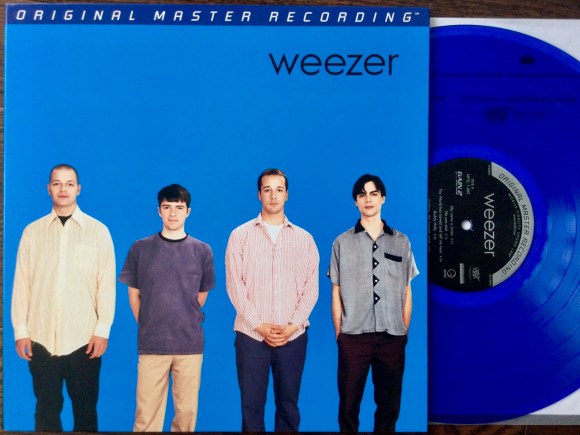
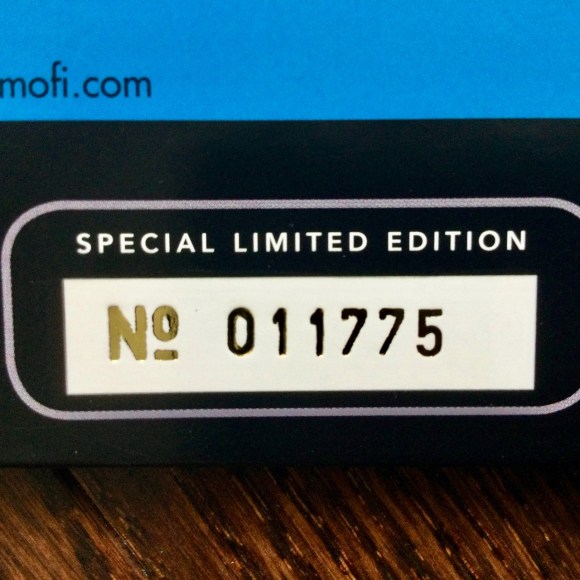
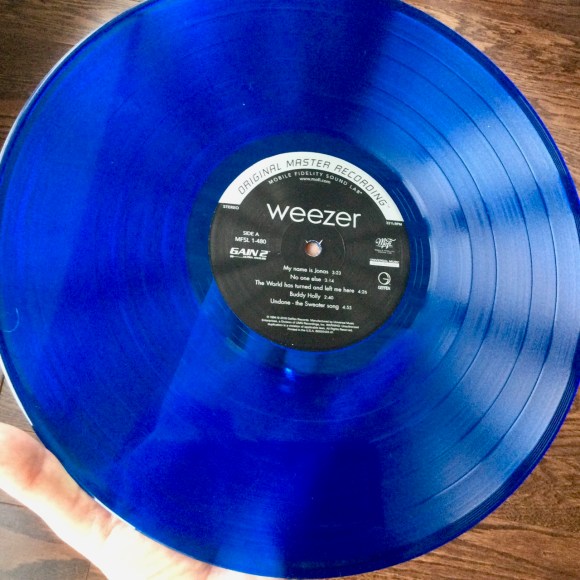
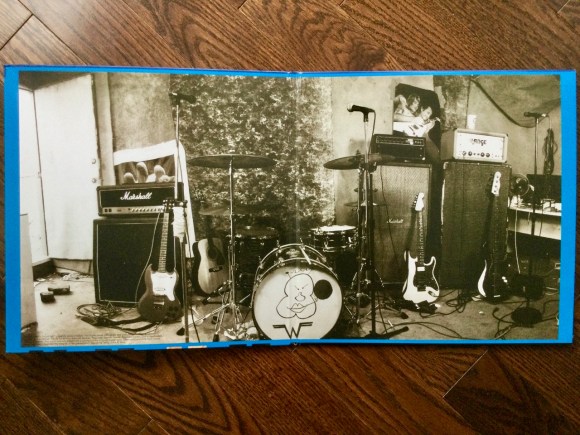
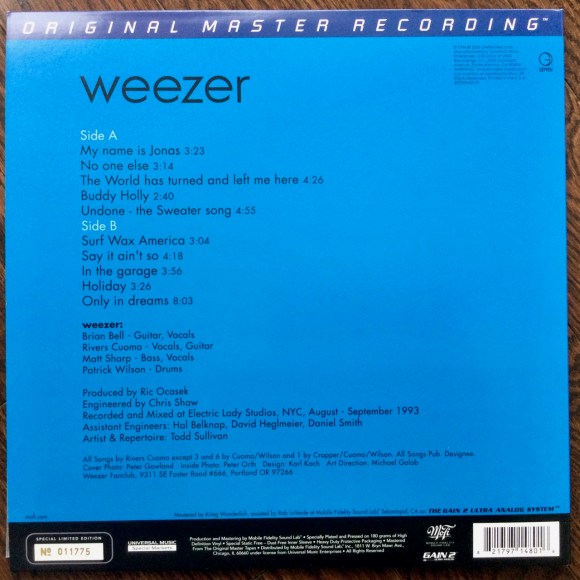
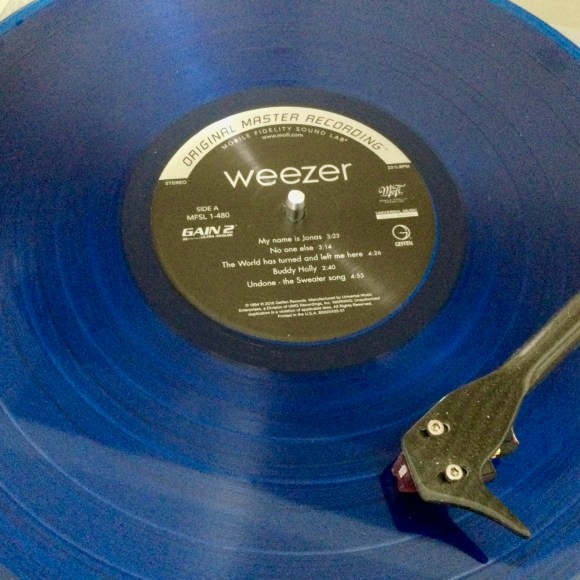
Artist: Weezer Album Title: Weezer Year released: 1994 Year reissued: 2016 Details: Mobile Fidelity, limited edition, numbered 011775, 180 gram, transparent blue
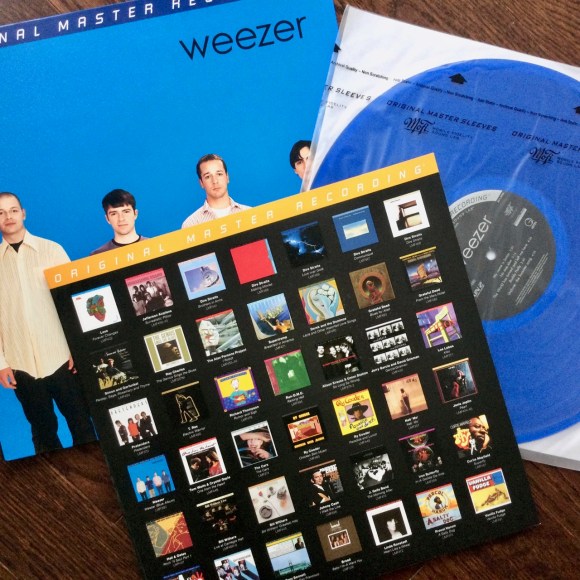
The skinny: Just over three weeks ago, fellow blogger Super Dekes over at Thunder Bay Arena Rock posted a review of Weezer’s self-titled album (also widely-known as ‘the Blue album’) and mentioned how he had finally gotten a copy of it on vinyl the previous summer. Coincidentally, I had tracked down a vinyl copy of it myself that very week and when I told Deke so, he suggested I also write a review. Well, I figured one of my ‘Vinyl love’ posts would work just as well, so here we are. I actually saw Weezer live before I heard this album. They opened for shoe gazers Lush at Toronto’s Warehouse in the summer ’94 and at the time, I was only vaguely aware of “The sweater song”. Nonetheless, I was blown away by their set – all crunchy guitars and Beach Boys harmonies – and told Rivers Cuomo as much when I spotted him at the merch table. A friend of mine in university later dubbed a copy of the album for me to cassette and I played the hell out of it. This debut is still Weezer’s most successful piece of music in my books, a classic, and though I spent a few dollars more than did Deke, it was well worth it to procure this limited edition Mobile Fidelity release. They do such a great job all round, what with the remastering, the pressing, and the immaculate packaging. Splendid.
Standout track: “The world has turned and left me here”


 My (life in) music lists