
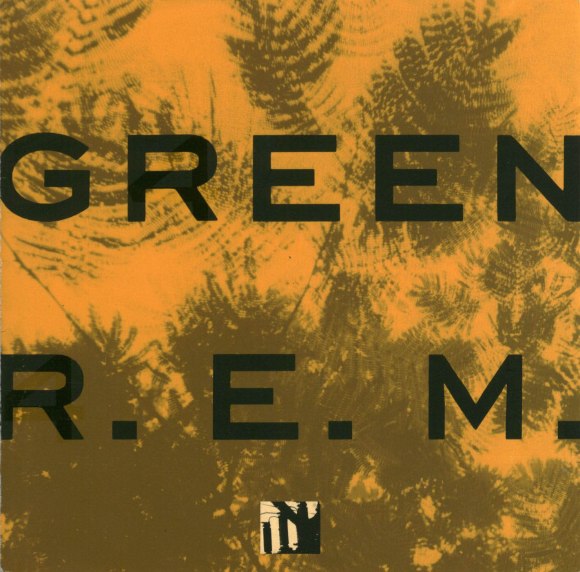
R.E.M.’s sixth album “Green” was the first album I owned by the band. In fact, this album’s second single, “Stand”, was my introduction to R.E.M.. I distinctly remember watching a music video show, though I can’t recall now whether it was a countdown or not, and the video for “Stand” being played in the same segment as Bobby McFerrin’s “Don’t worry, be happy”. (If that song gets stuck in your head today, I’m truly sorry.) I bought the album shortly afterward on cassette tape, but not just your run of the mill cassette. No. It was a ‘metal’ cassette, whatever that means. I likely paid a few extra dollars for that adjective too. Did I notice a difference? I was fourteen or fifteen, so likely not. Indeed, the only reason I remember this piece of trivia at all is that I still have said ‘metal’ cassette tape amongst my ‘things’ in a box in the basement.
“Green” was R.E.M.’s first album released on major label Warner Bros., having fulfilled their contract with I.R.S. the previous year. It was the second album of five produced by Scott Litt, a run of albums that can easily be considered R.E.M.’s glory years. It was the first album to introduce Peter Buck’s use of the mandolin, which would later be used as a basis for some of their biggest hits. So yeah, they were still being experimental and provocative on a major label and yet they saw greater success with the money backing them. The album hit both the US and UK album charts, saw a couple of hit singles, and went double platinum in the states. Perhaps the commercial success was related to those singles, which are easy to pick out from the album, sounding as if the band made a concerted effort to write hits, a possible concession to their label for allowing them such creative freedom.
It was these singles that definitely drew me to R.E.M. but I grew to love all of “Green” with repeat plays. As I mentioned above, this was my gateway to their excellent back catalogue and kept me coming back for future albums throughout the 90s. Two of my three picks for you are from these hit singles and the other, well, it’s a personal fave.
”Stand”: “Stand in the place where you live. Now face north. Think about direction. Wonder why you haven’t before.” The chorus of “Stand”, words which I’ve sung along with countless times, never wondering what they were all about, are, according to Michael Stipe and Peter Buck, among they stupidest and inane the band has ever come out with. Perhaps subconsciously this is why I’ve never thought too hard on them. Yeah, the song which introduced me to the group was purposely crafted to sound on par with the pop songs they loved from the 60s. It’s no wonder, then, that it’s so infectious and catchy. (Maybe not to the degree of “Don’t worry, be happy”. Whoops. Sorry.) The beat and melodious guitars just beg a hop and wriggle dance, not unlike the one featured in the video.
”World leader pretend”: Even before I learned that track five on side one was Stipe’s tribute to Leonard Cohen, I loved the tune. The wordplay, like on many R.E.M. tunes, is great, but particularly so here. “This is my mistake. Let me make it good. I raised the wall and I will be the one to knock it down.” The inner turmoil and internal war-waging game is strong and we are left guessing whether he wants to correct his mistake or make it a real doozy. Likely, it’s a bit of column A and a bit of column B. The instrumentation has always appealed to me on this song too, the pedal steel and cello further dampening the melancholy with a fresh run of tears. And Stipe nails it, resting his vocals on the low ledge, tentative and introverted.
”Orange crush”: “Stand” was a huge hit for the band but it wasn’t their first. “Orange crush” was the advanced promotional single and it was massive. Widely misunderstood, which is definitely not hard with Stipe’s purposefully vague lyrics, it is an anti-war song. And the hints are there, from the sampled military cadence and shuffling of boots to the machine gun guitar riffs and drum rhythms. The title is a reference to Agent orange (not the soda drink), a chemical weapon that was used indiscriminately during the Vietnam war, which brings a whole other level of hurt to this line. “I’ve had my fun and now it’s time to serve your conscience overseas (over me, not over me). Coming in fast, over me.” Heart breaking and beautiful and still with that R.E.M. jangle and shine.
Check back next Thursday for album #4. In the meantime, here are the previous albums in this list:
10. The Sugarcubes “Life’s too good”
9. Erasure “The innocents”
8. Billy Bragg “Worker’s playtime”
7. Jane’s Addiction “Nothing’s shocking”
6. Leonard Cohen “I’m your man”
You can also check out my Best Albums page here if you’re interested in my other favourite albums lists.


 My (life in) music lists