Track fourteen, the next stop on this short list of great songs from the year 2000 takes us to a hopping ditty off “Mass romantic”, the debut album by The New Pornographers.
But before I go there, I need to talk a little bit about “Fubar”, a Canadian indie film released in 2002 that has since amassed quite the cult following. It is the debut film by Canadian director Michael Dowse and was shot in mockumentary style on a digital camera and a tiny budget. The film focuses on two lifelong friends, Terry and Dean, metal heads, beer drinkers, and basically, hosers (for want of a better word). “Fubar” is as hilarious as it is sad and if it didn’t popularize the term “Giv’r”, it certainly didn’t hurt its proliferation in popular culture usage.
But why did I have to mention this film in relation to The New Pornographers’ “The slow descent into alcoholism”? First, because it’s a great Canadian film that could use another plug and reminder. Second, because its soundtrack boasted a playlist of classic Canadian rock tracks as covered by contemporary Canadian artists, including The New Pornographers’ rendition of “Your daddy don’t know” by Toronto. And finally, because Terry and Deaner appear in the video that Michael Dowse made for “The slow descent into alcoholism” (see below), doing what they do best: drinking beer and being hosers.
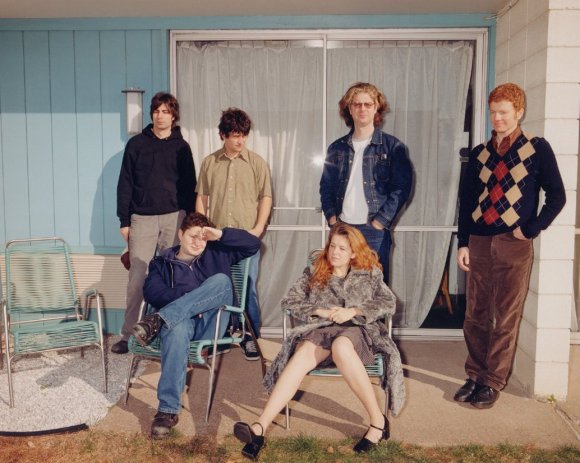
The New Pornographers formed in Vancouver in 1997 under the leadership of Carl Newman. It’s sometimes easy to forget that the band is really a collective and supergroup, and these days, even after seven albums together, all of its members (there are 8 of them!) still have other established projects on the go, some of them as well-known and successful as this one. What is so unique and incredible about The New Pornos is that they have lasted so long and that their sound is so cohesive, despite the different styles of its vocalists and principle songwriters: the aforementioned Newman, Dan Bejar, Neko Case, and Kathryn Calder (who didn’t join until 2005).
In trying to explain “Mass romantic”‘s immediate appeal and hook, critics have been quick to assign different iconic artists as comparison points to each song on the album. Apparently, “The slow descent into alcoholism” is David Bowie. And I suppose I can see a bit of glam rock and a touch of the theatrical in the verses and the way Newman delivers them. It’s a staccato rhythm driving the keys and vocals, all matched up with the ragtime drum beat. However, once Neko Case lovingly layers her soft and punchy backing vocals to Newman’s, all bets are off. Personally, I’ve never seen this band as derivative of any other sound and don’t really see eye-to-eye with those who take the lazy way out and shove them into the power pop pigeonhole. It’s a pop song, sure, and mighty powerful, but this group is one of a kind.
For the rest of the Best tunes of 2000 list, click here.
It’s hump day! So to celebrate, I am kicking off yet another list this lovely Wednesday morning. For those counting, that’s three lists I’ve got going, which should suffice to keep me busy for now. This excellent thirty-song list opens with “Get out”, a track off the debut album by Kingston, Ontario’s P.S. I Love You.
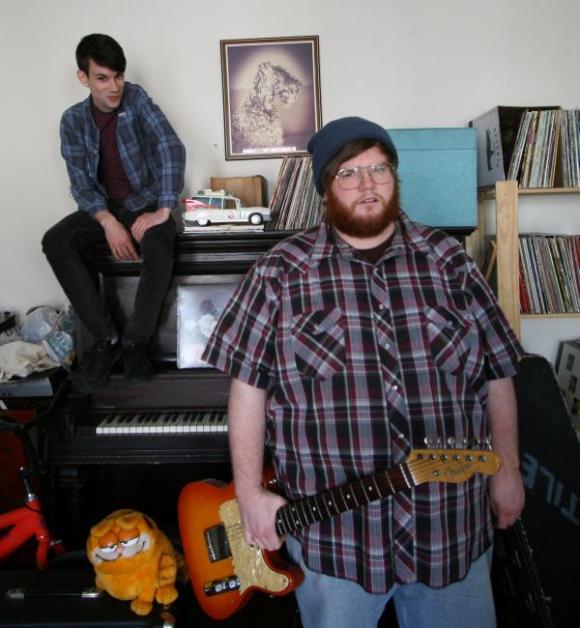
This duo, whose moniker is a play on the initials of its frontman, started out as a solo project for guitarist and vocalist, Paul Saulnier in 2006. He later added drummer Benjamin Nelson when he tired of fiddling with the drum machine on his keyboards. Up to now, they’ve released three long players on Canadian indie label, Paper Bag Records, the first of which was “Meet me at the muster station” in 2010.
I happened upon these guys the following year in 2011 when I saw them live at Ottawa Bluesfest, an annual two week music festival that has long-since stopped being only about the blues. Instead, it offers up a wide range of artists from across the spectrum of genres, a virtual marathon of musical splendor. I’ve been going for a number of years now but I think 2011 marked my third year in attendance and perhaps the year I started doing a boatload of research on the bands playing in preparation. P.S. I Love You was one of the artists that caught my attention almost immediately, earning a spot in my schedule with their pure raw energy. And as intense as their recordings are, their live show upped the ante substantially. Indeed, they didn’t have a large audience to start their set but by their final note, they had amassed quite an enthusiastic crowd. It wasn’t a lot of showboating or guitar noodling, just two guys rocking out on stage and making a lot of noise.
Truly, if you listened to any of the tracks on “Meet me at the muster station” without knowing any better, you might not realize there are only two musicians in the group. Like a couple of other duos I can think of, say The White Stripes or The Black Keys, they present a full sound with their limited personnel, but that’s where the comparisons end. Instead of crunchy blues rock, P.S. I Love You leans heavily towards punk and noise rockers, like Sonic Youth or Pixies. Indeed, you can hear the latter especially with Saulnier’s Frank Black-like yelp and snarl vocals.
“Get out” employs some monstrous earthquake guitar rumbles to kick start the frenetic rim-click drumming. A muscular bass line just adds to the pressure accentuated later on by some alien synth washes. It’s all a noisy cacophony that might be unlistenable in another set of hands but luckily for us, Saulnier has a sweet pop sensibility that brings at all together. Then, of course, when he tears in with his don’t-give-a-shit vocals, you feel like you can join in and scream along with him. This is a track that should not be played quietly.
For the rest of the Best tunes of 2010 list, click here.
Band members: John Mann (vocals, guitars) 1983-2016
Geoffrey Kelly (flutes, whistles, bodhran, guitars, vocals) 1983-2016
Hugh McMillan (multi-instrumentalist) 1986-2016
Vince Ditrich (drums) 1989-2016
Tobin Frank (bass, piano, organ, and accordion) 1997-2016
Matthew Harder (guitar) 2014-2016
J. Knutson (bass, bouzouki, guitar, mandolin, vocals) 1983-1986
Linda McRae (accordion) 1989-1996
Daniel Lapp (multiple instrument) 1988-1989
Discography: Spirit of the West (1984)
Tripping up the stairs (1986)
Labour day (1988)
Save this house (1990)
Go figure (1991)
Faithlift (1993)
Two headed (1995)
Open heart symphony (1996)
Weights and measures (1997)
Star trails (2004)
Context: Spirit of the West originated as the trio of John Mann, Geoffrey Kelly, and J. Knutson under the dubious moniker Eavesdropper. It wasn’t long, though, before the name was changed to Spirit of the West and the band began releasing albums of traditional folk music. After only two albums, Knutson left the group and was replaced by Hugh McMillan. Linda McRae was later added in time for their major label debut, “Save this house”. It was while on tour in support of this album that they met, performed, and became friends with The Wonder Stuff, another of my favourite 90s bands, in England.
The Stuffies would go on to influence Spirit of the West to experiment with more of a rock sound. They brought in drummer Vince Ditrich and “Go figure” was born, and afterwards, with each successive album, more and more of their early folk sound would give way to rock. Linda McRae left the band at the height of their popularity in 1996 and to my mind, they were never the same. They released two more albums, “Weights and measures” in 1997 and “Star trails” in 2004, and a couple of compilations but became mostly a touring outfit, albeit sporadically, for many years afterwards. In 2014, frontman John Mann announced he had been diagnosed with early onset alzheimers and although they continued to play shows for a while, with an additional guitarist and with Mann using an iPad to help with the lyrics, the band finally called it quits in 2016.
I have been a fan of Spirit of the West since high school and have seen them live many times over the years. There’s many good reasons that I’ve seen them so many times and own most of their albums, not least of which are the quality of their entertaining live performances, musicianship, songwriting, and the personal attachment I have to the material. So the news of their breakup struck me hard in 2018, even though it had been years since I had seen them perform and really, since they had released any new material. I had hoped that the band would make a swing through Ottawa on its final tour so I could see them play one last time. However, as it turned out, they didn’t and I had to be satisfied with watching footage from their last concerts online and watching the excellent documentary, “Spirit unforgettable”, that showed the band and Mann’s struggles in their final year.
Spirit of the West and their music will forever be inextricably tied to certain memories that I share with my wife, Victoria. They are one of the many bands I introduced her to years ago and they also played a special part in our collective history. It was on the night of one of their concerts back in 1996 that our relationship became more than the friendship it had been previously. We had known each other for three years already but on a night where we decided to go to a Spirit of the West show at the university pub together, everything just fell into place. We have since seen the band perform twice more and ensured that we included a few of their songs in the celebrations of our big day when we finally married back in 2009.
All that to say, Spirit of the West was a great band that deserved to be more successful than they were, as is evinced by the number of great musicians that turned up at their final shows as guests. For me, they will always rank up there was one of my all-time favourites.
The top five:
#5: And if Venice is sinking (from “Faithlift”, 1993)
Besides a certain drinking song that I’ll get to in just a bit, “And if Venice is sinking” would easily be the band’s most recognizable song. It was their highest-charting single off their best-selling record. It’s a joyful sounding tune, Linda McRae’s prominent accordion kept pace with the deep thumps of a tuba and the warbling strum on the mandolin, a carnival-like reflection of the energy of Northern Italy. Classic paintings, gondolas, and churches abound in the world famous living museum that is Venice. The lyrics were a reflection of John Mann’s honeymoon there and I couldn’t help humming the tune when my wife and I followed him there over fifteen years later on our own honeymoon. We, too, never wanted to leave such an enchanting city. “And if Venice is sinking, I’m going under, ’cause beauty’s religion and it’s christened me with wonder.” Indeed.
#4: Far too Canadian (from “Go figure”, 1991)
The music on “Go figure” was my very first introduction to the band. The cassette tape was pretty near a constant fixture in my Sony Sports Walkman in my final year of high school. The final song on the album was this six and a half minute number railing against the Mulroney Conservative government of the day and the perception of Canadians as quiescent sheep, starting off with Mann singing so forlornly over the strumming of his acoustic. He is later joined by the flute and accordion as the passion increases. I’ve always loved the song for its calling out of Canadians to be stronger than we appear. “I am the face of my country, expressionless and small, weak at the knees, shaking badly, can’t straighten up at all. I watch the spine of my country bend and break.” Going through my old things recently, I found my grade thirteen art journal and in it, I had written out the lyrics in total, surrounded by random doodles. Interestingly, the music video that I found for the song (below) is a collage of truly Canadian images, painting a completely different picture.
#3: The crawl (from “Tripping up the stairs”, 1986)
“Home for a rest” isn’t SOTW’s only great drinking song you know! Four years before they wrote about drinking through their way through the pubs in England, John Mann and Geoffrey Kelly penned this humdinger detailing an epic pub crawl along the north shore in Vancouver. Kelly takes the lead on vocals but Mann joins in on the roaring chorus: “Well, we’re good old boys, we come from the North Shore, drinkers and carousers the likes you’ve never seen. And this night, by God! We drank till there was no more, from the Troller to the Raven with all stops in between.” Though it is one of the band’s oldest songs, it was still a regular in their live sets right up to the end and perhaps because of its prominent place in their encores, it has long since become a fan favourite. From what I’ve read, many of the pubs referred to in the song still stand and fans and drinkers alike organize pub crawls along the route, hitting all the same pubs that the band purportedly did drink at regularly. Something to keep in mind for my next trip out west.
#2: Home for a rest (from “Save this house”, 1990)
You had to know that this song would be on this list somewhere but you likely had it pegged at the number one spot. For many Canadians, this is like an alternate national anthem and have spent many a beer-soaked night singing along with Mann and the rest of the group. What many people don’t know is that as popular as the track is, it was never released as a single off “Save this house”. It slowly grew in popularity over the years, reaching its apex in the late nineties, largely thanks to its inclusion on the popular “Frosh” CD compilations. It is a great track to say the least. The lyrics are smart and hilarious, some of my favourite that the band has written, like: “The gas heater’s empty, it’s damp as a tomb. The spirits we drank are now ghosts in the room. I’m knackered again, come on sleep take me soon and don’t lift up my head ’til the twelve bells of noon.” But with the exception of the slow, warming up intro, the pace is frenetic, perfect for hopping around, ‘Lord of the dance’ style on a packed pub dance floor. Personally, I’ll never forget a particular St. Patty’s day back in university where I got so blottoed that I got up to sing the vocals because the musical entertainment at the pub that evening didn’t know the words and the likewise drunken crowd wanted to hear it. It was an occasion that will likely never be repeated.
#1: Political (from “Labour day”, 1988)
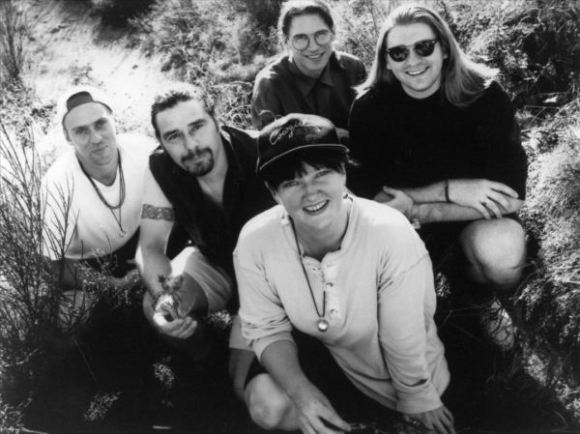
This song is so great the band recorded it twice. It originally appeared on 1988’s “Labour day” and later, with some added drums and a healthy dose of rock, was re-released on 1991’s “Go figure”. This latter version is the one I first heard and loved it from the beginning for both the words and the sound but after hearing the more stripped down original years later, I rarely choose to listen to the second version. I think many fans prefer the original. There’s even a story going around about how, back in the day, the band were presented with a signed petition asking them to play the song as it was originally arranged. The song itself is not politically charged, despite its name, but is actually about the end of a relationship, apparently based on John Mann’s ancient history with the near iconic frontwoman of Mecca Normal, Jean Smith. It also happens to be my wife Victoria’s favourite Spirit of the West song because some of the lyrics in the song remind her of the early days in our relationship. In a sense, I agree with her but unlike the subjects in the song, we survived the tumultuous days of our youth and lived to sing along with one of our favourite bands. “Why did everything, every little thing, every little thing with you and me have to be so political?”
For other top five lists in this series, click here.


 My (life in) music lists