Categories
Tunes

100 best covers: #67 The Sundays “Wild horses”

<< #68    |    #66 >>

I’m not really a huge Rolling Stones fan. However…

However, there are some of their tunes that I really like, mostly from their very early days. I purchased a copy of their compilation “Hot rocks 1964-1971” on cassette tape back when I was in high school and listened to it quite a bit on my Walkman. So I definitely recognized this cover by The Sundays when I first heard it. I distinctly remember being in the car, not far from home in Bowmanville, the town in which I spent my formative years. I was listening to the new music preview on CFNY on the car stereo and they were having some sort of cover song special. I particularly remember this fact because they also played another great cover song, one that will figure in later on this list so I won’t mention it here.

This cover by The Sundays was actually my introduction to the band. I really enjoyed the sound, which I would much, much later identify as dream pop, and thus, made a point of remembering their name. Still, it was a while before I made the connection between them and their big single, “Here’s where the story ends”, which I’d heard many times on the radio and now easily count as favourite by them. To this day, The Sundays are one of those bands that make me smile every time I hear them, even despite their often sad melodies.

Interestingly, their cover of The Rolling Stones’ “Wild horses” feels a bit more upbeat than the original, the acoustic strumming a bit more peppy than the sad lethargy and pining for home felt in Keith Richards’ electric accoutrements. Mick the balladeer was always enjoyable to me and on their original, he’s all very late night and tired, the mood slow burning and sobering, right to the bitter end, which closes up right around the six minute mark. The Sundays recorded their cover almost twenty years later and rather than a late night booze can, theirs evokes a vacuous chamber where all sound wavers and melts. All except for Harriet Wheeler’s vocals, which, instead, dance on a cloud, the quiet whispers and the plaintive and aching vocals, all call out into the wilderness, scream out to you for an embrace.

Do I prefer the cover or the original? Tough call, that one. Both are evocative of their time and place and energy. What do you think?

Cover:

The original:

For the rest of the 100 best covers list, click here.

Categories
Tunes

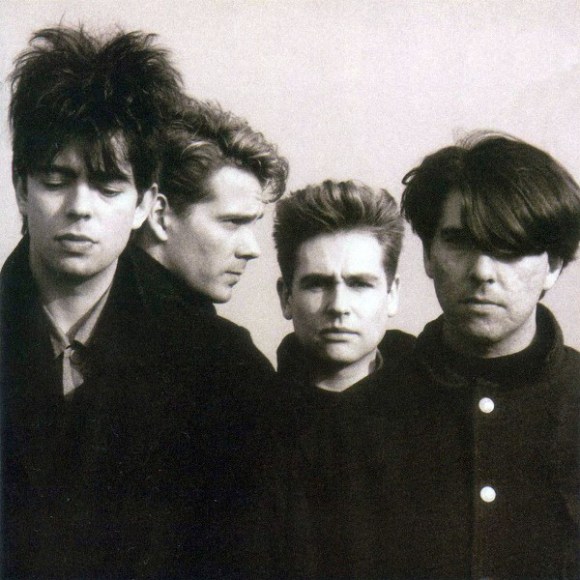
100 best covers: #68 Echo And The Bunnymen “People are strange”

<< #69    |    #67 >>

So this here’s another example of a cover that I heard first and with which I was quite familiar before finally hearing the original. Interestingly, though, both discoveries were the result of films from my youth and their soundtracks.

Echo & the Bunnymen’s cover of “People are strange” was featured on the soundtrack for the original “Lost boys” film, which came out in 1987. I remember watching it (against my parents’ wishes) as a teenager with my adopted older brother as soon as it was released to VHS. Was I scared? A bit. Okay, maybe a lot. A young Kiefer Sutherland was quite terrifying as a vampire. But I was a big fan of two Coreys back in the day and they were hilarious as the intrepid vampire hunters.

A few years after that, in 1991, the big film of the summer was Oliver Stone’s biopic, “The doors”, for which I was still just a tad too young to see in the theatres. I watched it on VHS, again, months later but the film had already done its work revitalizing the public’s interest in the 60s psych rock band and I fell in line, copying a friends copy of their ‘best of’ to cassette tape. It was here that I put the proverbial face and name to more than a few songs with which I was already familiar and discovered a few new favourites, including what I learned (the hard way) was the original version of “People are strange”.

I love Echo & The Bunnymen and this cover but I think I might give the edge to The Doors here. The latter’s musicianship, especially that of Ray Manzarek, often takes a back seat in the shadows of their infamous poet/frontman but it really is good stuff. The carnival/side show feel of the original “People are strange” is a lot of fun but the cover shades up on the sinister feel exponentially, which is not necessarily a bad thing (especially given the subject of the film on whose soundtrack it appears). Ian McCulloch’s vocals are more overtly darker than Morrison’s and the sound bleaker, yeah, the organs have more reverb (but really, Manzarek needed none of that).

Okay. I give up. Both versions are quite haunting… though for very different reasons. Thoughts?

Cover:

The original:

For the rest of the 100 best covers list, click here.
Categories
Tunes

100 best covers: #69 Cornershop “Norwegian wood (This bird has flown)”

<< #70    |    #68 >>

Chances are pretty good that if you haven’t heard tell of Cornershop, you’ve likely heard their huge, worldwide hit, “Brimful of asha”, bolstered in large part by the fabulous remix by Norman “Fatboy Slim” Cook. The original version of that track appeared on Cornershop’s third album, 1997’s “When I was born for the 7th time”. The album was released just past the apex of the Britpop craze and though neither their sound, style, politics, or ethos necessarily matched up with others from the scene, they were still lumped in with that lot simply because they were there. It was likely thanks to their appearance in the British music magazines I was in the habit of purchasing when I had the coin, and the aforementioned ubiquitous hit, that I purchased the album on CD during my final days of university*. And though I did like a lot of its tracks, it took me a few years to really appreciate what Tjinder Singh and Ben Ayres were doing. There was so much going on here – psych, funk, rock, dance, ambient, and traditional Indian music – and the culmination of all this was summed up in this fun cover of The Beatles’ “Norwegian wood (This bird has flown)”.

The original, I’m guessing, needs no introduction. Recorded way back in 1965 for the album “Rubber soul”, “Norwegian wood” is widely considered to be one of the first instances of ‘Raga rock’ and was also highly influential on the burgeoning psych rock movement. The song was written by John Lennon, apparently about an extramarital affair, with contributions from Paul McCartney, its composition inspired by the folk ballads of Bob Dylan. But it all really came together when George Harrison added a touch of sitar, an instrument he had just recently discovered and had started to learn, and all of a sudden, we had our first Western rock song to feature the Indian traditional stringed instrument.

So, in fact, it’s quite compelling that Tjinder Singh, whose band name was a play on the stereotypical vision of Indian immigrants in England, would choose to cover this particular track. Reportedly approved by both Paul McCartney and Yoko Ono, his cover translated the words to Punjabi, upped the sitar focus, and in a sense, whether intended or not, reclaimed the use of the instrument and shone a spotlight on his heritage.

It’s never a fair game to try to rank a cover against a Beatles original but I definitely think Cornershop’s version of this track is worth your time. What are your thoughts?

Cover:

The original:

*”When I was born for the 7th time” eventually wormed its way deeply amongst my favourites of 1997, one of the greatest years for music (in my opinion), and landed on my top ten when I counted them down a couple of years ago.

For the rest of the 100 best covers list, click here.