Categories
Tunes

100 best covers: #64 The Boo Radleys “There she goes”

<< #65    |    #63 >>

While looking for something to listen to on Spotify recently, I rediscovered that Alan Cross’s amazing radio show, “The ongoing history of new music”, is available on there as a podcast. I may be one of the only people that I know that never got into the concept of podcasts, always preferring to listen to music whenever the opportunity is afforded to listen to something, whether it be in the car, at work, or just puttering around the house. However, I always loved listening to Alan Cross’s radio show back when I was younger and living in Toronto, where his show was originally broadcasted on CFNY, and I decided to give the podcast a try. I’ve now listened to and enjoyed a few episodes (of course, Cross is still as interesting and engaging as ever) and can now see myself checking it out on the regular.

I mention this because in a weird coincidence the theme on the very first podcast episode to which I listened had for its theme, one-hit wonders of the 1990s, and in the middle of the show, Cross called The La’s’ “There she goes”, ‘the perfect pop song’. I myself included this very track and ranked it number one when I did a post on my top five one-hit wonders of the 1980s* a few years ago. In that post, I also referred to it as a perfect pop song, to the ‘jangly guitars that shimmer in the sunlight’ and how ‘Lee Mavers’ vocals alternate between rough and soft’.

This balance and counterpoint and the compact song structure and length is likely why so many artists have covered it and have had success with it. Indeed, “There she goes” has been covered by The Wombats, Robbie Williams, and by an American a cappella act called The Kingsmen. Perhaps most famously, Sixpence None The Richer covered it and released it as the second single off their self-titled album in 1999, the follow up to the ubiquitous hit, “Kiss me”. Their slowed down, acoustic focused version did quite well and sure, it’s lovely enough, but in my opinion, it completely dispenses with any of the edge on the original.

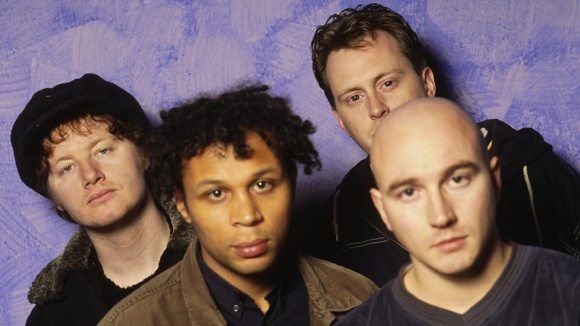
The cover version that I prefer is the one by British contemporaries, The Boo Radleys, and this can be attributed to the fact that I discovered it at the same time and place as I did the original. Both versions are featured on the soundtrack for the film, “So I married an axe murderer”** and the two together are, in a sense, a de fact theme song for the film. They book-end the album, the cover opening the proceedings and the original having the final word. I used to think they were pretty much the same but on closer inspection recently, I managed to separate the intricacies.

The Boo Radleys ease off a bit on the jangle by replacing the iconic arpeggio guitar intro with horns and they unbelievably one-up the original in peppiness by increasing the tempo, adding handclaps, and vocal harmonies. In another ‘how did they do it’ facet, The Boo Radleys’ version even managed to come out thirty seconds shorter than Lee Mavers’ perfect pop song length in the original.

Is the cover better? You won’t catch me answering the affirmative here – the original is so good – but I do enjoy both.

Thoughts?

Cover:

The original:

*”There she goes” was originally released as a single in 1988 but was re-released a couple of times in the 1990s. Hence, it being attributed to both the 1980s and the 1990s.
**It’s a great soundtrack, much better than the film for which it was put together. For a bit more on both, have a peek on my post on Suede’s “My insatiable one”, another track that appeared on the soundtrack.

For the rest of the 100 best covers list, click here.
Categories
Tunes

Best tunes of 1992: #4 Catherine Wheel “Black metallic”

<< #5    |    #3 >>

It’s kind of funny now seeing the term bandied about and used (and perhaps misused) to describe a lot of today’s bands and indeed, a lot bands describing themselves using the word and carrying the banner for ‘shoegaze’. Especially since, back in the day when it was coined, it was used with such derision and the bands affiliated with the sound did their best to distance themselves from it.

Catherine Wheel was one of these bands that hated the term. And yet their debut album, “Ferment”, was a textbook case in the sound – the effects pedals, the hazy and droning guitars, the uncertain vocals buried deep in the mix – and the advance single, the seven plus minute, “Black metallic”, has been called by many to be the “Like a hurricane” or “Stairway to Heaven” of the genre.

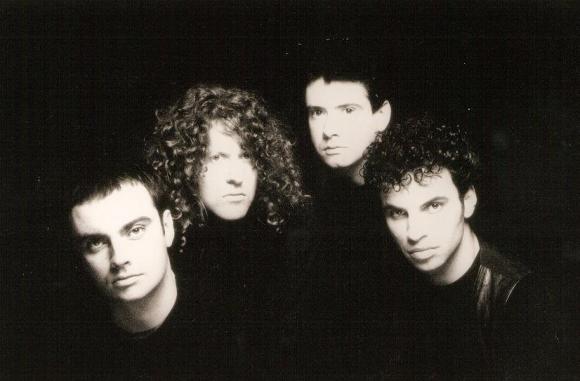
Catherine Wheel was formed in 1990 by guitarist Brian Futter, bassist Dave Hawes, drummer Neil Sims, and frontman Rob Dickinson*. They released a couple of shoegaze-informed EPs before signing to Fontana Records and re-recorded a bunch of tracks from those EPs to form the basis of “Ferment”. However, if you listen to the other four of their albums after the debut, you can hear Catherine Wheel slowly but surely beating the shoegaze out of their music. With each successive album, the alternative rock got a bit harder and more pedestrian and my own interest in them ebbed and flowed as they toyed with their sound. They did quite well in North America, though, a success outside of their native England that not many of the original shoegazers were able to achieve.

And it all started with this one, “Black metallic”, after its music video got picked up and was thrown into heavy rotation on MTV. The video was filmed using the 7” version and at just over four minutes, much shorter than the 12” version and the one that appears on “Ferment”. I prefer the longer version and I can’t imagine I’m alone with this opinion. It can almost be called a ballad and is definitely a love song. Or a falling-out-of-love song. The swoon-inducing line that is repeated throughout, comparing his lover’s skin to that of a car, could actually be Dickinson’s way of painting the love as gone cold.

“I’ve never seen you when you’re smiling
It really gets under my skin“

The reverb drenched guitar intro is quickly joined by a lazy beat and the chiming, swirling guitars. It all blends together like a dry ice fog, even in the quieter moments, where Dickinson’s vocals should be clear as day, they are still somehow obscured, the white noise, a figure in the room, a fifth player, a silent observer. These, of course, have their counterpoint and in the messy guitar rave outs and they are given plenty of room to breathe. The length of the song expands and exhales and yet still somehow doesn’t feel self-indulgent in the least. It’s beautiful and sleek, like the line of a fine muscle car and just as dangerous, when all revved up. Why don’t you take it out for a drive right now?

*Who some might be interested to know was the cousin of a certain Bruce Dickinson

For the rest of the Best tunes of 1992 list, click here.

Categories
Tunes

Best tunes of 2012: #20 Trampled By Turtles “Alone”

<< #21    |    #19 >>

Memory is funny thing. And as I get older, it’s only getting funnier. Yeah. These days, it’s damn right hilarious.

I have no idea at all how I ever came across Trampled by Turtles and their very excellent 2012 album, “Stars and satellites”. I’ve thought, at points, that they were one of those many bands that I’ve investigated over the years in anticipation of seeing them live at either Ottawa’s Bluesfest or the CityFolk festival. But that can’t be it because although they have played both of those festivals, each of these appearances occurred prior to and well after this album’s release and unfortunately, I missed both.

Then, I wondered if it was because I had gotten caught up the indie folk wave that had taken hold of pretty much everyone around this time, thanks, of course, goes out here to the success of England’s Mumford and Sons and the United States’ answer, The Lumineers. A very possible theory, this.

But the theory that I feel is most likely, is a simple one: They have one hell of a band name, don’t they?

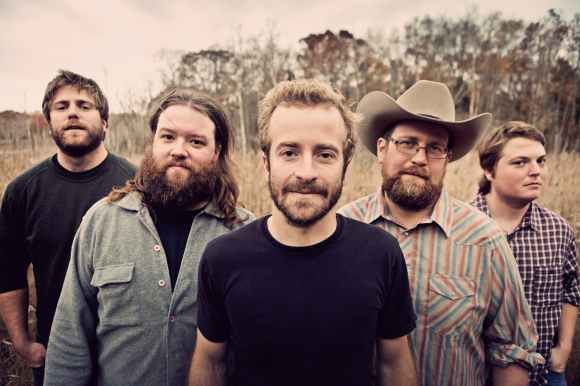
Trampled by Turtles formed in Duluth, Minnesota back in 2003. As far as I can tell, all six members – Dave Simonett. Tim Saxhaug, Dave Carroll, Erik Berry, Ryan Young, and Eamonn McLain – have been with the band since its inception and through the release of all nine of their albums. Since the beginning, they have maintained a hold on their bluegrass and folk underpinnings and man, are they talented.

One of the biggest standouts of their aforementioned fifth album, “Stars and satellites”, is this very track we are focusing on today: “Alone”. It is fresh and at the same time, old school to the nth degree. The rustic, acoustic guitar plucking is quickly joined by Dave Carroll, twanging and bouncing on the banjo and this not-so-torrid pace is maintained for the first minute or so while the frontman, Dave Simonett, finds his feet and then, locates in the darkness, his backing vocalists. Tim Saxhaug on the bass joins in next, in typical booming fashion, then Ryan Young eases his fiddle into the picture and finally, here, the pace explodes into all out ecstasy.

“The summer breezes blow so tall
And the winter nights are cold and so long
In between the falling leaves ooh“

There is a flitting and frittering sound coming from of all these stringed instruments. It is the falling leaves. It is a lonely wind. It is the sound of voices far off. It is dark here, there are plenty of stars in the sky, and if you follow them, you will find your way home.

For the rest of the Best tunes of 2012 list, click here.